The J.K. Rowling Index

List of all J.K. Rowling's writings.

Please read our read Frequently Asked Questions if you have any doubts.


The Sorting Hat

Index ID: PPSHAT — Publication date: September 6th, 2016

Note: This article was part of the e-book "Hogwarts: An Incomplete and Unreliable Guide", which is part of the Pottermore Presents collection. It's similar to the original version published on Pottermore, with minor additions.
Only the beginning of this text can be displayed here for research purposes. I apologize!

The famous Hogwarts Sorting Hat gives an account of its own genesis in a series of songs sung at the beginning of each school year. Legend has it that the hat once belonged to one of the four founders, Godric Gryffindor, and that it was jointly enchanted by all four founders to ensure that students would be sorted into their eponymous houses, which would be selected according to each founder’s particular preferences in students.


Previous writing: «

Next writing: »

The Hogwarts Express

Index ID: PPHE — Publication date: September 6th, 2016

Note: This article was part of the e-book "Hogwarts: An Incomplete and Unreliable Guide", which is part of the Pottermore Presents collection. It's similar to the original version published on Pottermore, with minor additions.
Only the beginning of this text can be displayed here for research purposes. I apologize!

As we know from early historical accounts, and from the evidence of early woodcuts and engravings, Hogwarts students used to arrive at school in any manner that caught their fancy. Some rode broomsticks (a difficult feat when carrying trunks and pets); others commandeered enchanted carts and, later, carriages; some attempted to Apparate (often with disastrous effects, as the castle and grounds have always been protected with Anti-Apparition Charms); others rode a variety of magical creatures.


Previous writing: «

Next writing: »

Silvanus Kettleburn

Index ID: PPSKET — Publication date: September 6th, 2016

Note: This article was part of the e-book "Short Stories from Hogwarts of Heroism, Hardship and Dangerous Hobbies", which is part of the Pottermore Presents collection. It's similar to the original version published on Pottermore, with minor additions.
Only the beginning of this text can be displayed here for research purposes. I apologize!

Silvanus Kettleburn was the Care of Magical Creatures teacher at Hogwarts until Harry’s third year, when he was replaced by Rubeus Hagrid.


Previous writing: «

Next writing: »

Animagi

Index ID: PPANIM — Publication date: September 6th, 2016

Note: This article was part of the e-book "Short Stories from Hogwarts of Heroism, Hardship and Dangerous Hobbies", which is part of the Pottermore Presents collection.
Only the beginning of this text can be displayed here for research purposes. I apologize!

An Animagus is a witch or wizard who can transform at will into an animal. While in their animal form, they retain most of their ability to think as a human, their own sense of identity and their memories. They will also retain normal human life expectancy, even if they take their animal form for long periods of time. However, feelings and emotions are simplified and they will have many animal desires, feeding off whatever their animal body craves, rather than demanding human food.


Previous writing: «

Next writing: »

Minerva McGonagall

Index ID: PPMMCG — Publication date: September 6th, 2016

Note: This article was part of the e-book "Short Stories from Hogwarts of Heroism, Hardship and Dangerous Hobbies", which is part of the Pottermore Presents collection. This piece, altough similar to the one published on Pottermore, has been updated for the e-book.
Only the beginning of this text can be displayed here for research purposes. I apologize!

Minerva McGonagall was the first child, and only daughter, of a Scottish Presbyterian minister and a Hogwarts-educated witch. She grew up in the Highlands of Scotland in the early twentieth century, and only gradually became aware that there was something strange, both about her own abilities, and her parents’ marriage.


Previous writing: «

Next writing: »

Polyjuice Potion

Index ID: PPPOLY — Publication date: September 6th, 2016

Note: This article was part of the e-book "Short Stories from Hogwarts of Power, Politics and Pesky Poltergeists", which is part of the Pottermore Presents collection. It's similar to the original version published on Pottermore, with minor additions.
Only the beginning of this text can be displayed here for research purposes. I apologize!

The Polyjuice Potion, which is a complex and time-consuming concoction, is best left to highly skilled witches and wizards. It enables the consumer to assume the physical appearance of another person, as long as they have first procured part of that individual’s body to add to the brew (this may be anything – toenail clippings, dandruff or worse – but it is most usual to use hair). The idea that a witch or wizard might make evil use of parts of the body is an ancient one, and exists in the folklore and superstitions of many cultures.


Previous writing: «

Next writing: »

Peeves the Poltergeist

Index ID: PPPEEV — Publication date: September 6th, 2016

Note: This article was part of the e-book "Short Stories from Hogwarts of Power, Politics and Pesky Poltergeists", which is part of the Pottermore Presents collection. It's similar to the original version published on Pottermore, with minor additions.
Only the beginning of this text can be displayed here for research purposes. I apologize!

The name ‘poltergeist’ is German in origin, and roughly translates as ‘noisy ghost’, although it is not, strictly speaking, a ghost at all. The poltergeist is an invisible entity that moves objects, slams doors and creates other audible, kinetic disturbances. It has been reported in many cultures and there is a strong association with the places where young people, especially adolescents, are living.


Previous writing: «

Next writing: »

Horace Slughorn

Index ID: PPSLUG — Publication date: September 6th, 2016

Note: This article was part of the e-book "Short Stories from Hogwarts of Power, Politics and Pesky Poltergeists", which is part of the Pottermore Presents collection.
Only the beginning of this text can be displayed here for research purposes. I apologize!

Horace Eugene Flaccus Slughorn was born into an ancient wizarding family, the only son of doting and wealthy parents. Although a fundamentally good-tempered boy, he was educated to believe in the value of the old boys’ network (his father was a high-ranking Ministry official in the Department of International Magical Co-operation), and encouraged to make friends ‘of the right sort’ once he arrived at Hogwarts. The Slughorn family is one of the so-called ‘Sacred Twenty-Eight’, (a select list of the only families designated ‘pure-blooded’ by an anonymous author in the 1930s) and while Slughorn’s parents were never militant in their pure-blood beliefs, they encouraged a quiet belief in the family’s innate superiority.


Previous writing: «

Next writing: »

Violent Femmes album for RAM

Index ID: VFRAM — Publication date: September 1st, 2016

I’m not quite sure how the Violent Femmes passed me by. I turned 18 the year this album came out, but I was obsessed with The Beatles at the time. Of contemporary bands I really loved, the standouts were the Smiths and the Psychedelic Furs. I loved any band with a great guitarist. I played guitar myself, mostly alone in my bedroom.

It’s possible that I heard the Violent Femmes but I’ve forgotten. They could easily have been part of the informal seminars on alternative music I received from the muso I dated in my late teens. His parents were Dutch and we hung out mostly at his house, because we were allowed to smoke in his attic bedroom. I’ve got happy memories of sunlit wooden rafters and smoke rings and walls covered in black and white pictures he’d clipped out of NME, while the Dead Kennedys, Jah Wobble or the Birthday Party blasted out of the speakers. Setting aside the fact that I had a pair of very long-lived goldfish named after Guggi and Gavin of the Virgin Prunes, I never became a whole-hearted convert of his favourite bands. Much as I adored him, I didn’t share Muso Boyfriend’s attitude to music: his scorn for the accessible and tuneful, the baffling mixture of irony and obsession with which he regarded his favourites, and his conviction that if the herd hates something, it’s almost certainly brilliant.

The NME was Muso Boyfriend’s bible and it took a hard line on nearly anything commercial or popular, talking about bands in the top ten with the kind of contempt most people reserve for child abusers. A few real Gods could be forgiven commercial success, obviously: people like Bowie or the Stones, but the likes of Nik Kershaw might as well have been Thatcher herself as far as NME were concerned

When the Stranglers released ‘Feline’ and it went to number 4 in the album charts, an NME journo went into meltdown, ranting about the fact that people who’d never heard ‘Rattus Norvegicus’ were now calling themselves Stranglers fans. You could almost see the flecks of spittle on the page. (I’d bought ‘Feline.’ I didn’t own ‘Rattus Norvegicus.’) And I still vividly remember an NME interview with Gary Kemp from Spandau Ballet, a band I never liked, though I admired Gary’s chutzpah in agreeing to talk to them. The interviewer’s disapproval of Gary and everything he stood for reached a glorious peak with the phrase ‘this whorehouse called success.’ I never made much headway arguing about this sort of thing with Muso Boyfriend, though, so after a bit of snogging I’d cycle home and listen to ‘Rubber Soul.’

My first live gig and my first music festival were both with Muso Boyfriend: Big Country at Dingwalls in Bristol, supporting act: John Cooper Clarke, the punk poet. We spent my 18th birthday at the Elephant Fayre in Cornwall, hitching there from South Wales. I’d told my parents some whopping lie about how we were getting there, probably that Muso Boyfriend’s older brother was driving us. Half an hour of unsuccessful hitching later, it suddenly occurred to me that my parents had said they were going shopping later. This meant they might soon be driving past us, so I kept diving for cover every time a Honda Civic came into view.

We finally got a lift, thank God, so I survived to enjoy my birthday at the Elephant Fayre. We pitched the two-person tent by a marquee full of Rastas selling tea and hot knives and saw the Cure, whom Muso Boyfriend was weirdly keen to hear, in spite of the fact that they’d actually been on Top of the Pops. The only other act I remember well from the Elephant Fayre is Benjamin Zephaniah. He did a poem about having the shit kicked out of him by a policeman. Twenty odd years later, I was on a team with him at a kids’ book quiz at the Edinburgh Book Festival.

You’ve now listened to it, at least 3 times, what do you think?

I didn’t Google the band or the album before listening, because that felt like cheating, so I knew virtually nothing about them except that this came out in 1983. When I told my friend Euan which album I was going to review he assured me I’d like it, but his favourite album’s by The Cramps, so that wasn’t entirely reassuring.

Wanting to concentrate, I go outside to my writing room in the garden, which has a wooden ceiling. This, unlikely as it may seem, is relevant information.

So I put on the Violent Femmes and hear a catchy acoustic guitar riff and I think, this is great! I’m going to love them! I’ll get a Violent Femmes T-shirt, buy the entire back catalogue and bore everyone rigid with my new obsession!

But then the vocalist kicks in and I have an immediate, visceral response of ‘no, scratch everything, I hate this.’ The change of mood is so abrupt my mind goes blank. I try to analyse why I moved from appreciation to intense dislike in a matter of seconds, but the best I can do is ‘I’ve heard voices like that before.’

By the time I reach track seven, all I can think about is the Toy Dolls’ cover of Nelly the Elephant. I’m not proud. I know this says more about me than the Violent Femmes.

After I’ve listened to the whole album once, I look down at the place where I was supposed to be making notes and all I’ve written is: ‘his upper register sounds like a bee in a plastic cup,’ which the professional writer in me recognizes as ‘not 500 words’. Feeling glum, I postpone a second listen to the following day.

It’s raining next morning and I can’t be bothered to go and find shoes, so I don’t take the album into the writing room, but stay in the kitchen. With minimal enthusiasm, I put on the album again.

This is weird. The vocalist is actually, um… good. Where did the bloke I heard yesterday go? Now I’m not busy hating him, I notice all the great hooks and how they sometimes sound like a manic skiffle band. There’s a nice bit of bluesy slide guitar and an actual xylophone on ‘Gone Daddy Gone’. Plus, when he half talks, half sings, Gordon Gano (I checked the album credits) sounds a bit Lou Reed, and I love Lou Reed. Apart from being the vocalist, Gano also happens to be the guitarist I fell for yesterday.

I can’t understand why he grated on me so much first time round. Beneath my wooden ceiling, he was the Ur-voice of all those NME-approved punky bands I never liked: nasal, whiny and brash. Today, sitting beside my kettle, he’s raw, catchy and soulful.

Only then, staring into a mug of tea, do I have the little epiphany that you, clever reader, saw coming a mile off. Listening to an album that reeks of 1983, in a room that bears a passing resemblance to that attic of long ago, was a mistake. It wasn’t Gordon Gano who was the problem: it was me. I was listening with a ghostly eighteen year old ex-boyfriend at my shoulder, and behind him, a chorus of snarling early eighties NME journalists, all ready to jeer, because even if I like the Violent Femmes, I’ll like them in the wrong way.

So the sun came out and I took the Violent Femmes back across the wet lawn into the writing room, telling myself that it’s not 1983 any more, and this is between me and the Violent Femmes, nobody else. On the third listen, I realized that I loved the album. Before I knew it, I was listening to it over and over again. Only then did I let myself look at their Wikipedia page.

The Violent Femmes, I read, were ‘one of the most successful alternative rock bands of the 1980s, selling over 9 million albums by 2005.’ Yes, the Violent Femmes ended up in that whorehouse called success, and you know what? It only makes me love them more.


Previous writing: «

Next writing: »

Lumos Charm Bracelet

Index ID: LCBR — Publication date: June 30th, 2016

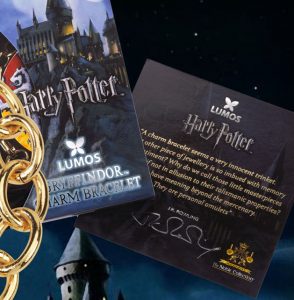
Note: Warner Bros. and movie prop and merchandise specialist The Noble Collection have created the Lumos Harry Potter Charm Bracelet Collection, available to purchase through The Noble Collection shop. At least 15% of the suggested retail price of the charm bracelet will go to Lumos Foundation. They included a presentation card with a message by J.K. Rowling.

A charm bracelet seems a very innocent trinket. What other piece of jewellery is so imbued with memory and sentiment? Why do we call those little masterpieces “charms” if not in allusion to their talismanic properties? They have meaning beyond the mercenary. They are personal amulets.

Lumos is a spell I created in HARRY POTTER that brings light to a desperately dark and frightening place.

At Lumos this is just what we do: we reveal the hidden children locked away behind closed doors and forgotten by the world, so that everyone first of all understands the problem and then works together to fix it.


The following images are related to this writing


Previous writing: «

Next writing: »