The J.K. Rowling Index

List of all J.K. Rowling's writings.

Please read our read Frequently Asked Questions if you have any doubts.


Time-Turner

Index ID: PMTT — Publication date: July 31st, 2013

New from J.K. Rowling

In spite of the many Muggle fantasies around the subject, time travel is possible in only a limited sense even in the magical world. While the subject is shrouded in great secrecy – investigations are ongoing in the Department of Mysteries – it appears that magic can take you only so far.

According to Professor Saul Croaker, who has spent his entire career in the Department of Mysteries studying time-magic:

As our investigations currently stand, the longest period that may be relived without the possibility of serious harm to the traveller or to time itself is around five hours. We have been able to encase single Hour-Reversal Charms, which are unstable and benefit from containment, in small, enchanted hour-glasses that may be worn around a witch or wizard’s neck and revolved according to the number of hours the user wishes to relive.

All attempts to travel back further than a few hours have resulted in catastrophic harm to the witch or wizard involved. It was not realised for many years why time travellers over great distances never survived their journeys. All such experiments have been abandoned since 1899, when Eloise Mintumble became trapped, for a period of five days, in the year 1402. Now we understand that her body had aged five centuries in its return to the present and, irreparably damaged, she died in St Mungo’s Hospital for Magical Maladies and Injuries shortly after we managed to retrieve her. What is more, her five days in the distant past caused great disturbance to the life paths of all those she met, changing the course of their lives so dramatically that no fewer than twenty-five of their descendants vanished in the present, having been “un-born”.

Finally, there were alarming signs, during the days following Madam Mintumble’s recovery, that time itself had been disturbed by such a serious breach of its laws. Tuesday following her reappearance lasted two and a half full days, whereas Thursday shot by in the space of four hours. The Ministry of Magic had a great deal of trouble in covering this up and since that time, the most stringent laws and penalties have been placed around those studying time travel.

Even the use of the very limited amount of Time-Turners at the Ministry’s disposal is hedged around with hundreds of laws. While not as potentially dangerous as skipping five centuries, the re-use of a single hour can still have dramatic consequences and the Ministry of Magic seeks the strictest guarantees if it permits the use of these rare and powerful objects. It would surprise most of the magical community to know that Time-Turners are generally only used to solve the most trivial problems of time-management and never for greater or more important purposes, because, as Saul Croaker tells us, just as the human mind cannot comprehend time, so it cannot comprehend the damage that will ensue if we presume to tamper with its laws.

The Ministry’s entire stock of Time-Turners was destroyed during a fight in the Department of Mysteries about three years after Hermione Granger was granted permission to use one at Hogwarts.

J.K. Rowling’s thoughts

I went far too light-heartedly into the subject of time travel in Harry Potter and the Prisoner of Azkaban. While I do not regret it (Prisoner of Azkaban is one of my favourite books in the series), it opened up a vast number of problems for me, because after all, if wizards could go back and undo problems, where were my future plots?

I solved the problem to my own satisfaction in stages. Firstly, I had Dumbledore and Hermione emphasise how dangerous it would be to be seen in the past, to remind the reader that there might be unforeseen and dangerous consequences as well as solutions in time travel. Secondly, I had Hermione give back the only Time-Turner ever to enter Hogwarts. Thirdly, I smashed all remaining Time-Turners during the battle in the Department of Mysteries, removing the possibility of reliving even short periods in the future.

This is just one example of the ways in which, when writing fantasy novels, one must be careful what one invents. For every benefit, there is usually a drawback.


Previous writing: «

Next writing: »

Werewolves

Index ID: PMWW — Publication date: July 31st, 2013

There are werewolves worldwide and they have traditionally been pariahs in the wizarding communities from which they often spring; witches and wizards who are frequently involved in hunting or studying such creatures are exposed to a higher risk of attack than the average Muggle. In the late nineteenth century the great English authority on werewolves, Professor Marlowe Forfang, undertook the first comprehensive study of their habits. He found that nearly all those he managed to study and question had been wizards before being bitten. He also learned from the werewolves that Muggles ‘taste’€™ different to wizards and that they are much more likely to die of their wounds, whereas witches and wizards survive to become werewolves.

The Ministry of Magic’s policies on werewolves have always been muddled and inefficient. A Werewolf Code of Conduct was developed in 1637, which werewolves were supposed to sign, promising not to attack anyone but to lock themselves up securely every month. Unsurprisingly, nobody signed the Code, as nobody was prepared to walk into the Ministry and admit to being a werewolf, a problem from which the later Werewolf Registry also suffered. For years, this Werewolf Registry, on which every werewolf was supposed to enter their name and personal details, has remained incomplete and unreliable, because so many of the newly-bitten sought to conceal their condition and escape the inevitable shame and exile. Werewolves have been shunted between the Beast and Being divisions of the Department for the Regulation and Control of Magical Creatures for years, because nobody could make up their minds whether a werewolf should be classified as human or bestial. At one point, the Werewolf Registry and Werewolf Capture Unit were both in the Beast Division, while at the same time an office for Werewolf Support Services was established in the Being Division. Nobody ever presented themselves for Support Services, for the same reasons that very few ever signed the Registry, and it was eventually closed down.

To become a werewolf, it is necessary to be bitten by a werewolf in their wolfish form at the time of the full moon. When the werewolf’€™s saliva mingles with the victim’s blood, contamination will occur.

The many Muggle myths and legends surrounding werewolves are, in the main, false, although some contain nuggets of truth. Silver bullets do not kill werewolves, but a mixture of powdered silver and dittany applied to a fresh bite will ‘seal’€™ the wound and prevent the victim bleeding to death (although tragic tales are told of victims who beg to be allowed to die rather than to live on as werewolves).

In the second half of the twentieth century, several potions were devised to soften the effects of lycanthropy. The most successful was the Wolfsbane Potion.

The monthly transformation of a werewolf is extremely painful if untreated and is usually preceded and succeeded by a few days of pallor and ill health. While in his or her wolfish form, the werewolf loses entirely its human sense of right or wrong. However, it is incorrect to state (as some authorities have, notably Professor Emerett Picardy in his book Lupine Lawlessness: Why Lycanthropes Don’€™t Deserve to Live) that they suffer from a permanent loss of moral sense. While human, the werewolf may be as good or kind as the next person. Alternatively, they may be dangerous even while human, as in the case of Fenrir Greyback, who attempts to bite and maim as a man and keeps his nails sharpened into claw-like points for the purpose.

If attacked by a werewolf that is still in human form, the victim may develop certain mild, wolfish characteristics such as a fondness for rare meat, but otherwise should not be troubled by long-term ill effects. However, any bite or scratch given by a werewolf will leave lasting scars, whether or not he or she was in a wolf’€™s form at the time of the attack.

While in its animal form, the werewolf is almost indistinguishable in appearance from the true wolf, although the snout may be slightly shorter and the pupils smaller (in both cases more ‘human’€™) and the tail tufted rather than full and bushy. The real difference is in behaviour. Genuine wolves are not very aggressive, and the vast number of folk tales representing them as mindless predators are now believed by wizarding authorities to refer to werewolves, not true wolves. A wolf is unlikely to attack a human except under exceptional circumstances. The werewolf, however, targets humans almost exclusively and poses very little danger to any other creature.

Werewolves generally reproduce by attacking non-werewolves. The stigma surrounding werewolves has been so extreme for centuries that very few have married and had children. However, where werewolves have married human partners, there has been no sign of their lycanthropy being passed to their offspring.

One curious feature of the condition is that if two werewolves meet and mate at the full moon (a highly unlikely contingency which is known to have occurred only twice) the result of the mating will be wolf cubs which resemble true wolves in everything except their abnormally high intelligence. They are not more aggressive than normal wolves and do not single out humans for attack. Such a litter was once set free, under conditions of extreme secrecy, in the Forbidden Forest at Hogwarts, with the kind permission of Albus Dumbledore. The cubs grew into beautiful and unusually intelligent wolves and some of them live there still, which has given rise to the stories about ‘werewolves’€™ in the Forest – stories none of the teachers, or the gamekeeper, has done much to dispel because keeping students out of the Forest is, in their view, highly desirable.


Previous writing: «

Next writing: »

Secret Keeper

Index ID: PMSK — Publication date: July 31st, 2013

The Fidelius Charm is extremely ancient and still used to this day. It involves the concealment of information inside a living person. The chosen person, or Secret Keeper, is the only person who is thenceforth capable of revealing the protected information to others, however many previously knew it. If the Secret Keeper shares the hidden information, the person to whom he or she has confided it will be bound by the Fidelius Charm and find it impossible to pass the information on.

The Fidelius Charm is not without its weaknesses. If the Secret Keeper wishes to do so, they may divulge the information at any time (although the secret cannot be forced, bewitched or tortured out of a Secret Keeper who does not wish to give up their secret; it must be given voluntarily). If the Secret Keeper dies, anyone to whom he or she has confided the information will become a Secret Keeper. This could involve many people, any of whom might be more willing to share the secret.

Generally speaking, being a Secret Keeper is a dangerous position to occupy. It is such a serious and binding enchantment that few would undertake it lightly. In spite of the fact that the secret can only be given up voluntarily, many have been subjected to the Imperius and Cruciatus Curses in an effort to make them share their information.


Previous writing: «

Next writing: »

Goodreads: J.K. Rowling on How She Crafts Gritty, Realistic Characters

Index ID: GRANSW — Publication date: July 25th, 2013

Note: To celebrate the paperback release of The Casual Vacancy, Goodreads asked the best-selling author's fans to submit their questions about the book. Goodreads then chose five finalists and polled members on their favorite. The winning question was answered by J.K. Rowling.

The most haunting idea I was left with came from your gritty exposure of ugliness and weakness of human nature (it’s far too easy, after all, to write about the potential and existent beauty of our natures). How important is it to you that this kind of real-ness exists in your characters? And if your hope was to showcase this, do you have a goal in mind, in terms of how we can rise above or grow from humanity at its worst?
– Goodreads member Anne Gunden

This is a great question and I’m very glad it was chosen! Yes, it was very important to me that the characters felt like real people, with their confused motives and their complicated lives. Thomas Hardy, a writer who knew a lot about the desperation of poverty and of quiet rural lives, wrote: ‘If way to the better there be, it exacts a full look at the worst.’

I see the vast majority of the characters in The Casual Vacancy as trapped by circumstance, by their life choices or a mixture of both and I have especial sympathy for all five teenagers – Andrew, Fats, Sukhvinder, Gaia and Krystal – who are all suffering from what an astute reader described to me as ‘casual parenting’.

One of the things I thought about a lot while writing was how hard it is to change your life even as an adult, though some people face much bigger obstacles in doing so than others. Gavin Hughes, for instance (a character for whom I can muster very little affection or sympathy), is really blocked only by his own timidity and inertia. I find his total disengagement and his self-absorption unsympathetic and I must admit that (having my ignoble side as much as the next person) I rather enjoy Samantha’s goading of him. Then we have Kay, who has made a disastrous change to her life in moving to be near her disinterested boyfriend; Samantha, whose accidental pregnancy irrevocably changed her life and, at the fat end of the spectrum, Terri Weedon. She has been damaged so young and is so severely addicted, trapped among people who use or abuse her, that almost every aspect of her thought process, her emotional state and her external circumstances would have to be transformed to alter the course of her life.

Two major themes of the novel are hypocrisy and responsibility. I wanted to show how humans can have ugly feelings that they might prefer not to acknowledge; how we’re all caught up in our own problems and limited by our own life experience. To judge somebody else, to declare them substandard, to conclude that their misfortunes are due to inherent character flaws, can be a way of boosting our own self-esteem, because it must follow that our comparative success or happiness is not mere luck or chance, but the reward for superior morals or talent.
Yet none of that has to stop us doing wonderful things; perfection is not necessary to make a real and lasting difference to other people’s lives. Barry Fairbrother was not a saint in the eyes of his grieving wife; he may have stretched himself too thin in his determination to make a difference to the people trapped in the same kind of childhood he escaped, but had he lived, Krystal and Robbie would have lived, too.

You ask about rising above our baser nature to effect real change in the world and I feel that many of my characters do that at the end of the book. Colin shows real bravery, compassion and forgiveness for his deeply damaged son; has become Fats’ sole source of comfort. Kay has faced up to her own motives in moving to Pagford, resolved to repair the damage and been reconciled with her daughter. Parminder has recognised the bravery and the trauma of the daughter onto whom she has projected all her own dissatisfaction and insecurities. Perhaps most importantly of all, Samantha Mollison, who has been so discontented throughout the story, who has been scathing of the possibilities offered by government to make any real change, volunteers to join the local council. We are left with the impression that she will not vote with her husband; that she and Colin Wall will fight to keep the addiction clinic open and prevent more drug-related calamities.
The awful knowledge that she could have saved a small boy’s life has jolted Samantha out of her complacency and she wants to be absorbed in something bigger than herself. I suppose that is my real answer to the second part of your question: we need to become absorbed in something bigger than ourselves. That doesn’t mean that everyone should stand for parliament (God forbid); it is a more subtle business than that. If we make decisions in small matters in the awareness that our actions can have huge impact on others, we will begin to make a difference. If we choose to understand the other person’s point of view, if we make the effort to understand before rushing to judgment, all kinds of different vistas might become apparent to us. This might sound very little, but the effects could be world changing and many people would rather not do this much. It feels comfortable and secure to adhere to one viewpoint and not shift (I very much include myself in everything written here, by the way!)

In the final analysis, The Casual Vacancy was constructed so that when three characters walk past a small, unaccompanied boy who is wandering between a dangerous river and a road, we understand why none of them stopped to ask him why he was alone, or take charge of him. I chose each of those characters carefully. Gavin represents the utter apathy for which it is necessary (in the famous quotation) for evil to flourish. He cannot even remember seeing Robbie Weedon after he hears that he has drowned, nor is he troubled by the thought that he must have walked very close to the boy during his final moments.

Samantha represents the rush of everyday troubles that prevents basically well-intentioned people from concentrating on matters that do not directly concern them. She subsequently admits to having seen Robbie and feels deep remorse at not having acted. Samantha is also honest enough to acknowledge to herself that Robbie’s appearance made her less likely to help him.
Shirley represents a degree of unkindness that stems from her own basic insecurity, because her background is not so very far removed from that of the Weedons. I think it is very common for such people to be among the most critical and judgmental. She – not Howard – is Barry Fairbrother’s true opposite in the novel. Denying her roots and castigating those who remind her of them, she is the negative image of the man who admits where he came from and goes back to try and help others. Shirley not only sees Robbie and ignores him as she grapples with her own problems, she feels no remorse afterwards, merely heaping blame on others for the child’s death.

An interesting question is whether Howard would have stopped to help Robbie. I’d be fascinated to know what readers think, but I’m sure he would have done. Howard is a happy man, which makes a difference; happy people are often kinder than the unhappy. What is more, Howard can appreciate hardship and suffering when it is personalized. For instance, he pays credit to Cath Weedon, whom he acknowledges to have had a hard life and to have done her best in spite of all her disadvantages. Confronted with a dirty little boy wandering beside the river, I can well imagine Howard taking him firmly by the hand and leading him off the police station. However much I might disagree with Howard on many issues, he has his code, and it is not devoid of a decency that I think is absent in his wife.

This has been a discursive answer, but I was stimulated by the question!


Previous writing: «

Next writing: »

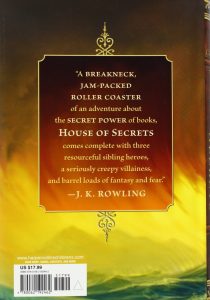
Cover quote: House of Secrets

Index ID: CQHOS — Publication date: April 23rd, 2013

Note: Cover quote for "House of Secrets" by Chris Columbus and Ned Vizzini.

A breakneck, jam-packed, rollercoaster of an adventure about the secret power of books, House of Secrets comes complete with three resourceful sibling heroes, a seriously creepy villainess, and barrel loads of fantasy and fear.


The following images are related to this writing


Previous writing: «

Next writing: »

Firebolt

Index ID: PMFBOLT — Publication date: April 10th, 2013

In the late twentieth century, the Nimbus Racing Broom Company dominated its competition. The Nimbus Two Thousand and Two Thousand and One models outsold all other top-class brooms combined by a factor of three to one.

Little did the Nimbus designers realise that a racing broom was in development that would knock them from their number one spot within twelve months of its release. This was the Firebolt, a top-secret project developed by Randolph Spudmore (son of Able Spudmore of Ellerby and Spudmore, who produced the Tinderblast in 1940 and the Swiftstick in 1952, both serviceable brooms, but never achieving great popularity).

A skillful and innovative broom designer, Randolph was the first to use goblin-made ironwork (including footrests, stand and twig bands), the secrets of which are not fully understood, but which seem to give the Firebolt additional stability and power in adverse weather conditions and a special non-slip foot grip that is of particular advantage to Quidditch players. The handle is of polished ebony and the twigs of birch or hazel according to personal preference (birch is reputed to give more ‘oomph’ in high ascents, whereas hazel is preferred by those who prefer hair-trigger steering).

The Firebolt is a costly broom and Harry Potter was among the first to own one. It continues to be made in relatively small quantities, partly because the goblin workers involved in the patented ironwork are prone to strikes and walkouts at the smallest provocation.


Previous writing: «

Next writing: »

Dementors and Chocolate

Index ID: PMDCH — Publication date: April 10th, 2013

The mood-enhancing properties of chocolate are well known in both the Muggle and wizard worlds. Chocolate is the perfect antidote for anyone who has been overcome in the presence of Dementors, which suck hope and happiness out of their surroundings.

Chocolate can only be a short-term remedy, however. Finding ways to fight off Dementors – or depression – are essential if one is to become permanently happier. Excessive chocolate consumption cannot benefit either Muggle or wizard.


Previous writing: «

Next writing: »

Gobstones

Index ID: PMGOBS — Publication date: April 10th, 2013

Gobstones is an ancient wizarding game that resembles marbles, the principal difference being that every time a point is conceded, the winning stone squirts a foul-smelling liquid into the loser’s face. Players start the game with fifteen small, round Gobstones each (Gobstones are sold in sets of thirty) and the winner must capture all of his opponent’s stones. Though most commonly (as the name implies) made of stone, Gobstones may also be made of precious metals.

Professional Gobstone players compete in national leagues and international tournaments, but it remains a minority sport within the wizarding world, and does not enjoy a very ‘cool’ reputation, something its devotees tend to resent. Gobstones is most popular among very young wizards and witches, but they generally ‘grow out’ of the game, becoming more interested in Quidditch as they grow older. The National Gobstone Association has attempted recruitment campaigns such as ‘Give Gobstones A Second Glance’, although the choice of accompanying picture (current Gobstones World Champion Kevin Hopwood being squirted with an eyeful of gunk) was perhaps ill-chosen.

Gobstones enjoys limited popularity at Hogwarts, ranking low among recreational activities, way behind Quidditch and even Wizarding Chess.

The mother of Professor Severus Snape, Eileen Prince, was President of the Hogwarts Gobstone Club in her time at school.


Previous writing: «

Next writing: »

The Marauder’s Map

Index ID: PMMMAP — Publication date: April 10th, 2013

New from J.K. Rowling

Perhaps no students (even including Harry Potter, Ron Weasley, Hermione Granger and Tom Riddle) have ever explored the castle and grounds of Hogwarts as thoroughly and illicitly as the four creators and contributors to the Marauder’s Map: James Potter, Sirius Black, Remus Lupin and Peter Pettigrew.

James, Sirius and Peter were not initially impelled to explore the school grounds by night out of devilment alone (though that played its part), but by their desire to help their dear friend Remus Lupin to bear his lycanthropy. Prior to the invention of the Wolfsbane Potion, Lupin was compelled to undergo an excruciating transformation every full moon. Once his condition was discovered by his three best friends, they sought a way to render his transformations less solitary and painful, which led to them learning to become (unregistered) Animagi, so that they could keep him company without harm to themselves. The ability of Sirius Black, Peter Pettigrew and James Potter to become, respectively, a dog, a rat and a stag, enabled them to explore the castle grounds by night undetected. The interior of the castle, meanwhile, was mapped over time with the help of James Potter’s Invisibility Cloak.

The Marauder’s Map is lasting testimony to the advanced magical ability of the four friends who included Harry Potter’s father, godfather and favourite teacher. The map they created during their time at Hogwarts appears to be a blank piece of parchment unless activated by the phrase: I solemnly swear that I am up to no good, a phrase that, in the case of three of the four makers, should be understood as a joke. The ‘no good’ of which they wrote never denoted Dark magic, but school rule-breaking; similar bravado is evinced by their use of their own nicknames on the map (‘Messrs Moony, Wormtail, Padfoot and Prongs’).

The magic used in the map’s creation is advanced and impressive; it includes the Homonculous Charm, enabling the possessor of the map to track the movements of every person in the castle, and it was also enchanted to forever repel (as insultingly as possible) the curiosity of their nemesis, Severus Snape.

Although the precise circumstances surrounding the makers’ loss of their map are not given in the Harry Potter novels, it is easy to conclude that they eventually over-reached themselves and were cornered by Argus Filch, probably on a tip-off from Snape, whose obsession it had become to expose his arch-rival, James Potter, in wrongdoing. The masterpiece of a map was confiscated in Sirius, James, Remus and Peter’s final year and none of them were able to steal it back from a well-prepared and suspicious Filch. In any case, their priorities changed in their final months at school, becoming far more serious and focused on the world beyond Hogwarts, where Lord Voldemort was successfully rising to power. All four of the map’s creators would shortly be inducted into the renegade organisation headed by Albus Dumbledore, the Order of the Phoenix, and a map of their old school – no matter how ingenious – would no longer be of use to them except as a piece of nostalgia.

The Marauder’s Map was, however, of immense use to the young Weasley twins. The story of Fred and George’s acquisition of the map is told in Harry Potter and the Prisoner of Azkaban. It was a mark of their high esteem for Harry Potter, and their belief that he stood in need of assistance with a destiny none of them yet fully understood, that they later gifted the map to him, unwittingly passing it on to the child of one of the creators.

The map was subsequently confiscated from Harry Potter by a Death Eater in disguise at the school, who recognised it as a likely source of his own discovery.”

J.K. Rowling’s Thoughts

The Marauder’s Map subsequently became something of a bane to its true originator (me), because it allowed Harry a little too much freedom of information. I never showed Harry taking the map back from the empty office of (the supposed) Mad-Eye Moody, and I sometimes regretted that I had not capitalised on this mistake to leave it there. However, I like the moment when Harry watches Ginny’s dot moving around the school in Deathly Hallows, so on balance I am glad I let Harry reclaim his rightful property.


Previous writing: «

Next writing: »