Monday 15 March 2004
Progress on Book Six
Book six is well underway, hooray, though I am still at the stage where I have a large and complicated chart propped on the desk in front of me to remind me what happens where, how, to whom and which bits of crucial information need to be slipped into which innocent-looking chapters. I started writing Harry Potter Six before my son David (who has just turned one) was born, but then took a bit of a break during the serious sleep-deprivation phase of his babyhood. I am really enjoying writing this book, though for the first time I am conscious that I am approaching the end of the series. So much of what happens in book six relates to book seven that I feel almost as though they are two halves of the same novel. Regular visitors to this site will find information about what’s in book six if they can work out where to look. Patience is the key.
Monday 15 March 2004
Mugglenet Chatroom Uninterested in JKR’s Theories
A few weeks ago I did something I’ve never done before and took a stroll into a Harry Potter chat room: specifically, MuggleNet’s chat room. Although I was concerned to find that many of the moderators feel their spiritual home is Slytherin, this is a great site. Nobody was remotely interested in my theories about what’s going to happen in book seven, though. In the end, I gave up trying to impart any gems of wisdom and joined in the discussion about SpongeBob SquarePants (don’t ask). I would like to take this opportunity to say that the practise of calling Lord Voldemort ‘Voldie’ must stop, as must the insistence that with a bit of therapy ‘Voldie’ would be a real sweetheart. I might drop in again some time to check that you’ve done as you’ve been told. Look out for ‘Squidward’.
Monday 15 March 2004
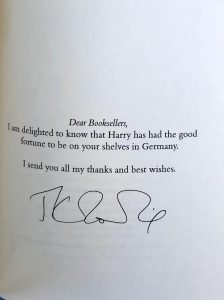
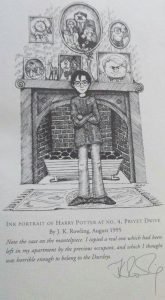
Forged JKR Signatures
If you or any of your loved ones is thinking of buying a ‘signed’ Harry Potter book, please be careful. The number of forged signatures has increased greatly over the last few years. You should be particularly suspicious of signed copies of ‘Order of the Phoenix’. I have never done a book signing for ‘Phoenix’, so signed British copies are very rare, American copies even rarer and other foreign editions (so far) virtually non-existent. Any copy of ‘Phoenix’ purporting to have been signed at the ‘Picadilly’ signing is highly likely to be a fake, for instance. I sign books for charity and in special circumstances but, as explained in the FAQ section, I can no longer begin to keep up with the demand for signed books. Unfortunately there are unscrupulous people who are only too ready to step into the breach and exploit Harry Potter fans.
Wednesday 2 June 2004
Reaction to JKRowling.com
Watching Harry Potter fans spread the news about this site, work out all the riddles in about ten minutes, collect all the prizes, then proceed to hack the site apart looking for more clues… well, I must say I never dreamed that sitting in front of a computer could be so much fun. I can see that this site is going to be a great source of entertainment and amusement to me. I would like to make two points: firstly, as I said in a recent interview, if there is ever a time when I am not doing updates, it is because I am writing hard. Either way, you win! Secondly, since the updated website went live, many people have been enthusiastically emailing Christopher Little, my agent, Colman Getty, my PR firm, and even Lightmaker, who run the site. None of these people can answer such emails, nor will they be passed to me. As I say in my ‘welcome’ note, this website has been created precisely because I cannot answer fans individually any more. You will find my response to some of the rumours about the site in (where else?) Rumours.
Wednesday 2 June 2004
London Premiere of Prisoner of Azkaban
I first saw ‘Prisoner of Azkaban’ a few weeks ago when it was barely finished. I loved it immediately: it is my favourite Harry Potter film so far, so I was looking forward to seeing it again on Sunday. The premiere was fun, as always. It was the first time I had met Gary Oldman, David Thewlis and Michael Gambon, all of whom do a really magnificent job in the film. And it was, as ever, great to see Dan, Rupert and Emma, who get taller and better looking (and in Emma’s case, more beautiful) every time I see them, and are still, miraculously, the most grounded, least egotistical teenage actors you are ever likely to meet. The last time I saw Dan at the after-premiere party he was encircled by a group of determined female fans who were not keen on letting anyone else near him, and that included passing writers, but we managed to shout a few words at each other… Somebody from Warner Bros. offered me one of the giant, blow-up Aunt Marges that they had tied around the front of the cinema, but I thought it would have been more fun to untie them and let them drift over the country for the next couple of days. Pink Floyd did it with that giant inflatable pig… but most of the people reading this will be too young to know what on earth I’m talking about.
Tuesday 29 June 2004
Title of Book Six: The Truth
Well, the door opened at last and I showed you the title of book six – the genuine title, the title that will appear on the published book, the title I have been using in my head for ages and ages. Unfortunately, however, the door opened on the very same day the ‘Pillar of Storgé’ hoaxer struck, which left a lot of Harry Potter fans bemused as to whether I was having a joke at their expense by posting another fake title to ‘teach hoaxers a lesson’, something I certainly wouldn’t do, as it would simply frustrate, confuse or annoy the 99.9% of you who aren’t hoaxers! I tried to give a clear hint that the title behind the door was the real one by making the ‘Toenail’ joke as well (see ‘Rumours’). But just to clear up matters once and for all… Information you take directly from this site will be truthful and accurate (I might occasionally joke, but as time goes on, you’ll learn to tell when I’m joking). Do not trust anybody else claiming to have found information on this site that you cannot access, however seemingly convincing the images they provide to support their story. I never post information on the site that I do not want fans to read immediately. In other words, anybody claiming to have ‘discovered’ a message that wasn’t due for release yet is lying. There was never anything meaningful behind the door until the ‘Do Not Disturb’ sign came off! The ‘Pillar of Storgé’ was never my title, and I did not change it at the eleventh hour because I was ‘found out’ (I nearly fell off my chair giggling when I read this). I was delighted to see that a hard core of super-bright fans knew that the real title was once, in the long distant past, a possibility for ‘Chamber of Secrets’, and from that deduced that it was genuine. Certain crucial pieces of information in book six were originally planned for ‘Chamber of Secrets’, but very early on (first draft of Chamber) I realised that this information’s proper home was book six. I have said before now that ‘Chamber’ holds some very important clues to the ultimate end of the series. Not as many as six, obviously, but there is a link. Anyway: if you continue to exercise patience, you will find that the Do Not Disturb Door opens again… and again… giving you further hints about book six. But as a little bonus, and compensation for having been messed around by Mr. or Ms. Storgé, I shall tell you one thing without making you shift any bricks at all: the HBP is neither Harry nor Voldemort. And that’s all I’m saying on THAT subject until the book’s published.
Saturday 10 July 2004
JKR APPEARING AT EDINBURGH BOOK FESTIVAL
I will be reading and answering questions at the Edinburgh Book Festival on 15th August this year. This will be my fifth appearance at the Edinburgh Festival; there have been readings for each of the first four Potter books, and this time my appearance will coincide (roughly) with the UK publication of ‘Order of the Phoenix’ in paperback. I am looking forward to this event very much, because there will be a relatively small audience, which means I can see faces and take questions directly from the fans. Of course, events such as the readings at the Toronto Skydome and the Albert Hall are incredible, but nothing can replace the pleasure of interacting with enthusiastic readers, as opposed to waving at a sea of skin coloured blobs. As the number of tickets is restricted, they will be available by ballot rather than on a first come, first served basis. To apply for tickets, buy the Herald newspaper on Saturday 10th July or the Sunday Herald on 11th July to get a ballot form, or visit Bloomsbury’s website at www.bloomsbury.com, where you can apply online from Monday 12th July.
Saturday 24 July 2004
JKR EXPECTING THIRD CHILD
I am really delighted to say that I am expecting a third baby, who is due next year. I always wanted three children, so I could not be happier. Now, I know that many Harry Potter fans’ first reaction will be what does this mean for the timing of book six? (I’m not maligning you… I’m sure you’re happy for me… but I know you really want that book!) So let me reassure you that book six remains well on track and, fingers crossed of course, I don’t foresee any baby-related interruptions or delays. I still can’t say for sure when it will be finished, but I have written a lot and I really like it (a reckless challenge to fate, that; I bet the next chapter goes horribly wrong now).
Sunday 15 August 2004
J K Rowling at the Edinburgh Book Festival
Lindsey Fraser: Well, we must be the luckiest five hundred people in Edinburgh today. My name is Lindsey Fraser and I am delighted to congratulate you, on behalf of the Edinburgh International Book Festival, on getting up so early on this Sunday morning. Welcome to this very special event. Of course, J K Rowling does not need an introduction, so my job is really very easy today. Thanks to the Harry Potter books, her life has changed dramatically— I am sure that you know how the story goes. Thanks to the Harry Potter books, our lives have changed as well. We are part of an international readership and that is reflected in the fact that some of the people here today have travelled from far and wide. It is like a huge reading club that is immersed in the world that she has created. She does not often talk directly to her readers these days, and no wonder. She is too busy writing huge thick books to get out much, but she has made an exception today, first to read from her latest novel and then to take some of your questions. I know that you want to show how very pleased you are to see her today. Ladies and gentlemen, Jo Rowling. J K Rowling: Morning. I am going to do a very short reading for you from Harry Potter and the Order of the Phoenix, and then I will take some questions. Is there anyone here who has not finished reading the book? I know that there is someone at the back, because I know her and she told me. They seem to be mainly grown-ups: would that be right? If there are any younger people who have not finished reading the book, we need to be careful not to give away the big ending, if you know what I mean. If you have questions about the big ending, maybe you could save them for when you get your book signed afterwards. I try not to ruin people’s appreciation of the book if they are still reading it, so I have chosen a reading from quite early on in the book, just before Harry goes back to Hogwarts. He and Ron get quite a surprise—for Harry, it is quite an unpleasant surprise, I have to say. J K Rowling read an excerpt from Harry Potter and the Order of the Phoenix. Questions from the audience Out of all your books, which one is your favourite? It varies. I would have to say that it is probably Harry Potter and the Prisoner of Azkaban, although at the moment—it is unfair of me to say it—Harry Potter and the Half Blood Prince is my favourite book. Sorry. I am the only one who has read it and I think it is rather good. I am normally like this when I write a book. Usually when I am just over halfway I normally love it, but by the time I finish it I completely despise it and think it is worthless rubbish. At the moment, I really like how the sixth book is going. A lot happens in the sixth book and a lot of questions are answered. I really have a sense that we are nearly there and it is time for answers, not more questions and clues, although obviously there are a few clues as I am not quite finished yet. I hope that that is sufficiently frustrating for you, knowing that you can’t read it yet! Which books did you read when you were a child and which books do you read now? When I was a child, I would read absolutely anything. My favourite books for younger people would be I Capture the Castle by Dodie Smith, which I really love, The Little White Horse, all the classic children’s books… I love E Nesbit—I think she is great and I identify with the way that she writes. Her children are very real children and she was quite a groundbreaker in her day. I also read a lot of adult books. The last novel that I read was Wilkie Collins’ The Moonstone, which I have been meaning to read for years. It is a cracking read. I have just been on holiday and, for the first time in five years, I did not take any Iris Murdoch with me, because it is so depressing. I was just about to put one in my case and I thought, “Why do this? Why put yourself through this?”, so I didn’t bother. I read Wilkie Collins instead and it was a much better experience. All the paintings we have seen at Hogwarts are of dead people. They seem to be living through their portraits. How is this so? If there was a painting of Harry’s parents, would he be able to obtain advice from them? That is a very good question. They are all of dead people; they are not as fully realised as ghosts, as you have probably noticed. The place where you see them really talk is in Dumbledore’s office, primarily; the idea is that the previous headmasters and headmistresses leave behind a faint imprint of themselves. They leave their aura, almost, in the office and they can give some counsel to the present occupant, but it is not like being a ghost. They repeat catchphrases, almost. The portrait of Sirius’ mother is not a very 3D personality; she is not very fully realised. She repeats catchphrases that she had when she was alive. If Harry had a portrait of his parents it would not help him a great deal. If he could meet them as ghosts, that would be a much more meaningful interaction, but as Nick explained at the end of Phoenix—I am straying into dangerous territory, but I think you probably know what he explained—there are some people who would not come back as ghosts because they are unafraid, or less afraid, of death. Who is your favourite character in the books? I have loads of favourite characters. I really like Harry, Ron, Hermione, Hagrid and Dumbledore. I love writing Snape—even though he is not always the nicest person, he is really fun to write. I love writing Dudley. If I could meet anyone, I might choose Lupin. I really like him. My favourite new character is Luna—I am very fond of her. Is Aunt Petunia a Squib? Good question. No, she is not, but—[Laughter]. No, she is not a Squib. She is a Muggle, but—[Laughter]. You will have to read the other books. You might have got the impression that there is a little bit more to Aunt Petunia than meets the eye, and you will find out what it is. She is not a squib, although that is a very good guess. Oh, I am giving a lot away here. I am being shockingly indiscreet. How do you think of all the names, like Moony, Wormtail, Padfoot and Prongs? Those names all came out of the creatures that they turned into. I had a lot of fun with those. Wormtail was the most difficult one. My sister loathes rats and her problem with them is their tails, so that is what gave me the idea. You actually know how I get some names because I stole your Mum’s maiden name, didn’t I? You have to be careful if you get friendly with me because you tend to turn up in my books, and if you offend me, you often turn up as a nasty character. I found the name McClaggan the other day, which I think is a great name. There is a McClaggan in book six because I thought that it is a surname that is too good to waste. In your stories, will Harry Potter ever grow up as a wizard? Well, I don’t think it is giving too much away to say that he will survive to book seven, mainly because I do not want to be strangled by you lot, but I am not going to say whether he grows any older than that because I have never said that. You are good at putting me on the spot! Are any of your characters based on real people? The only character who is deliberately based on a real person is Gilderoy Lockhart. [Laughter]. Maybe he is not the one that you would think of, but I have to say that the living model was worse. [Laughter]. He was a shocker! The lies that he told about adventures that he’d had, things he’d done and impressive acts that he had committed… He was a shocking man. I can say this quite freely because he will never in a million years dream that he is Gilderoy Lockhart. I am always frightened that he is going to turn up one day. He is just one of those people from your past whom you feel you have never quite shaken off. I will look up one day at a signing and he will say, “Hello, Jo”. [Laughter]. Other people have contributed the odd characteristic, such as a nose, to a character, but the only character who I sat down and thought that I would base on someone is Gilderoy Lockhart. It made up for having to endure him for two solid years. Have you written any other books apart from the Harry Potter books? No. I have written other things that have not been published, which I assure you is no great loss to the world. I have written all sorts of different things but nothing else has been published. Some of it might be published one day—I don’t know. There are some unfinished things that I would quite like to finish but I do not know that I would want them to be published. Of the many, many characters in your books, whose personality is most like yours? There is a theory that every character is an extension of the author’s character, which makes me one of the most disturbed people, I think. [Laughter]. I do not know how many characters I’ve got, but it is nudging up towards 200, so I am really in trouble. Hermione is a bit like me when I was younger. I did not set out to make Hermione like me but she is a bit like me. She is an exaggeration of how I was when I was younger. Harry is a bit like me. If you squeeze together Harry, Ron and Hermione… I find them quite easy to write, and I think that that is because they are a bit like different parts of my personality. When you get to someone like Dolores Umbridge, no way—I am absolutely not like her. She is a horrible woman. What form does Dumbledore’s Patronus take? Good question. Can anyone guess? You have had a clue. There was a little whisper there. It is a phoenix, which is very representative of Dumbledore for reasons that I am sure you can guess. What will the seventh book be called? I think you have been put up to that. [Laughter]. I was asked about Harry Potter and the Order of the Phoenix live on American television by a boy who was just as good looking as you and just as cute. I just said it. I had said no to all the journalists, then a little boy just like you put up his hand and said, “What is the name of the next book?” I said, “Harry Potter and the Order of the Phoenix”! But I am not going to tell you, I’m sorry. You have no idea of the trouble that I would be in if I did. My agent would have me hunted down and killed, so I am not going to say. Why is the barman of the Hog’s Head vaguely familiar to Harry? Is he Dumbledore’s brother? Ooh—you are getting good. Why do you think that it is Aberforth? [Audience member: Various clues. He smells of goats and he looks a bit like Dumbledore]. I was quite proud of that clue. That is all that I am going to say. [Laughter]. Well yes, obviously. I like the goat clue—I sniggered to myself about that one. Are you happy with the films that have been made? I am happy with the films. Of the three, Azkaban is my favourite. I thought it was really good for a lot of different reasons. I thought that Alfonso Cuaron, the director, did a fantastic job and Dan, Emma and Rupert, who play Harry, Hermione and Ron, were really wonderful in the film—I told them that. How do you make up the weird names for the potions? Sometimes invention gives out. I was writing the latest chapter of Harry Potter and the Half Blood Prince and I needed to come up with another name for another potion. I sat for ten minutes at the keyboard then I just typed “X”. I thought, “I’ll go back and fill that in later.” Sometimes you really want to get on with the story. Sometimes names just come to you, which is a great feeling, but sometimes it is difficult and you have to batter your brain for a while. Sometimes it comes to you while you are washing up or on the loo or something. My husband is quite used to me saying, “Wait!” then running up stairs and writing something down. What do you do in your spare time? I have no spare time at all. [Laughter]. When I’m not writing or looking after the children, I read and sleep. To be totally honest with you, at the moment sleeping is probably my very favourite thing in the world to do. I know that is a bit of a depressing answer. I would like to say I was partying with Mick Jagger—well, I wouldn’t want to be partying with Mick Jagger, that is a complete lie, but it would be a more interesting answer to give you here at the festival. Who was the first character that you invented? Harry. He really is the whole story. The whole plot is contained in Harry Potter; his past, present and future—that is the story. Harry came to me first and everything radiated out from him. I gave him his parents, then his past, then Hogwarts, and the wizarding world got bigger and bigger. He was the starting point. Does Hermione have any brothers or sisters? No, she doesn’t. When I first made up Hermione I gave her a younger sister, but she was very hard to work in. The younger sister was not supposed to go to Hogwarts. She was supposed to remain a Muggle. It was a sideline that didn’t work very well and it did not have a big place in the story. I have deliberately kept Hermione’s family in the background. You see so much of Ron’s family so I thought that I would keep Hermione’s family, by contrast, quite ordinary. They are dentists, as you know. They are a bit bemused by their odd daughter but quite proud of her all the same. Does Harry have a godmother? If so, will she make an appearance in future books? No, he doesn’t. I have thought this through. If Sirius had married… Sirius was too busy being a big rebel to get married. When Harry was born, it was at the very height of Voldemort fever last time so his christening was a very hurried, quiet affair with just Sirius, just the best friend. At that point it looked as if the Potters would have to go into hiding so obviously they could not do the big christening thing and invite lots of people. Sirius is the only one, unfortunately. I have got to be careful what I say there, haven’t I? If you could be one of the characters for a day, who would it be? Definitely not Harry, because I would not want to go through it all. I know what is coming for him so there is no way that I would want to be him. At the moment, I would not want to be any of them, because life is getting quite tough for them. It would be a laugh to be someone like Peeves, causing mayhem and not bothering. Will Ron and Hermione ever get together? Well—[Laughter.] What do you think? [Audience member: I think they will]. I’m not going to say. I can’t say, can I? I think that, by now, I’ve given quite a lot of clues on the subject. That is all I’m going to say. You will have to read between the lines on that one. Have you always wanted to be a book author? Yes. I know that I wanted to be a writer when I was six because I wrote a book then. It was a work of towering genius about a rabbit called Rabbit. I gave it to my mother and she said, “That’s lovely”, as a mother would, “That’s very, very good.” I stood there and thought, “Well, get it published then”. That’s a bit of an odd thing for a child of six to think. I don’t know where it came from. I thought, “Come on, then. Proofs? Galleys?” I obviously really wanted to do it. No one in my family wanted to write. My sister writes very funny letters but they are always about one paragraph long. She does not keep it going in the way that I do. Can you tell me more about Rita Skeeter? I love Rita. You know when Harry walks into the Leaky Cauldron for the first time, in Harry Potter and the Philosopher’s Stone? Everyone says, “You’re back” and he realises for the first time that he is famous. In a very early draft, Rita, a journalist, was there and she ran up to him. For some reason she was called Bridget—I forget why. Anyway, she detained him too long in the Leaky Cauldron and I really needed to get him moving, so I thought that I would not put her there. As I was writing book one, I was planning the rest, and book four was supposed to be where Harry’s fame became a burden to him. It really starts to weigh on him when he is exposed to the wider wizarding world so I thought that that would be the perfect place for Rita to come in. She was still called Bridget at the time. I didn’t realise that by the time I wrote book four I would have met quite a lot of Ritas and people would assume that I was writing Rita in response to what had happened to me, which was not in fact the truth. However, I am not going to deny that writing Rita was a lot more fun having met a few people I had met. I actually quite like Rita. She is loathsome—morally, she’s horrible—but I can’t help admiring her toughness. She is very determined to do the job and there is something quite engaging about that. There is more to come on Rita. It is really enjoyable to write her and Hermione because they are such very different people. The scene in which I had Hermione, Rita and Luna together in the pub was really fun to write because they are three very different women with very different points of view. You have this very cynical journalist, you have Hermione, who is very logical, upright and good, and you have Luna, who is completely out to lunch but fantastic. I really like Luna. You have these three people who are not on each other’s wavelengths making a deal. It was fun to write. You have probably had a lot of people trying to get information out of you about the books, but what is the strangest thing, or maybe the slyest thing, anyone has done? Have you ever slipped up? Well, you are pretty sneaky. People ask questions like, “Will there be an eighth novel and will Harry be in it?” There are questions that I simply can’t answer. Fans are very good at that, and I have to be very awake. I think that you want to know but you don’t want to know as well. You would all like me to tell you exactly what happens in books six and seven and then to erase your memories so that you can read them. I know, because that is how I feel about things that I really enjoy. I would kind of like to do it, but at the same time I know that I would ruin it for everyone. I thought that I would give you something though, rather than get to the end of today and think that I have not given you a lot. There are two questions that I have never been asked but that I should have been asked, if you know what I mean. If you want to speculate on anything, you should speculate on these two things, which will point you in the right direction. The first question that I have never been asked—it has probably been asked in a chatroom but no one has ever asked me—is, “Why didn’t Voldemort die?” Not, “Why did Harry live?” but, “Why didn’t Voldemort die?” The killing curse rebounded, so he should have died. Why didn’t he? At the end of Goblet of Fire he says that one or more of the steps that he took enabled him to survive. You should be wondering what he did to make sure that he did not die—I will put it that way. I don’t think that it is guessable. It may be—someone could guess it—but you should be asking yourself that question, particularly now that you know about the prophesy. I’d better stop there or I will really incriminate myself. The other question that I am surprised no one has asked me since Phoenix came out—I thought that people would—is why Dumbledore did not kill or try to kill Voldemort in the scene in the ministry. I know that I am giving a lot away to people who have not read the book. Although Dumbledore gives a kind of reason to Voldemort, it is not the real reason. When I mentioned that question to my husband—I told Neil that I was going to mention it to you—he said that it was because Dumbledore knows that there are two more books to come. As you can see, we are on the same literary wavelength. [Laughter]. That is not the answer; Dumbledore knows something slightly more profound than that. If you want to wonder about anything, I would advise you to concentrate on those two questions. That might take you a little bit further. Will Hagrid ever succeed with his plans for his brother? In a limited way, yes. Grawp is obviously the very stupidest thing that Hagrid ever brought home. In his long line of bringing home stupid things—Aragog, the Blast-Ended Skrewts—Grawp is the one that should have finished him off, but ironically it might be the one time that a monstrous something came good. By the next book, Grawp is a little bit more controllable. I think you got a clue to that at the end of Phoenix, because Grawp was starting to speak and to be a little bit more amenable to human contact. How did Dumbledore get his scar in the London Underground? You may find out one day. I am very fond of that scar. How do you think up the names of the books? Sometimes it was really easy and the title came naturally out of the plot. Sometimes it was a bit of a struggle. Harry Potter and the Chamber of Secrets had different titles. In fact, as everyone now knows, it was once called Harry Potter and the Half Blood Prince, but then I removed a whole storyline that did not work at all. It gave too much information too early, so I pulled it out and it became a major part, but not the only part, of book six. There is no trace of that storyline left in Chamber of Secrets. People have been speculating that book six is a spinoff of book two, but it is not. I was really upset when Sirius was taken… No, no, we can’t. We’ll talk about it afterwards. I think we have given it away anyway, but never mind. It has recently been confirmed that Blaise Zabini is in fact a male character. Will we see more of him in the next few books? That’s correct. You do. Also, will we see more of Snape? You always see a lot of Snape, because he is a gift of a character. I hesitate to say that I love him. [Audience member: I do]. You do? This is a very worrying thing. Are you thinking about Alan Rickman or about Snape? [Laughter]. Isn’t this life, though? I make this hero—Harry, obviously—and there he is on the screen, the perfect Harry, because Dan is very much as I imagine Harry, but who does every girl under the age of 15 fall in love with? Tom Felton as Draco Malfoy. Girls, stop going for the bad guy. Go for a nice man in the first place. It took me 35 years to learn that, but I am giving you that nugget free, right now, at the beginning of your love lives. In the fifth book, Harry can see the Thestrals. Can you? Yes, I can, definitely. That is a really good question, because it enables me to clear up a point. The letters that I’ve had about the Thestrals! Everyone has said to me that Harry saw people die before could see the Thestrals. Just to clear this up once and for all, this was not a mistake. I would be the first to say that I have made mistakes in the books, but this was not a mistake. I really thought this one through. Harry did not see his parents die. He was one year old and in a cot at the time. Although you never see that scene, I wrote it and then cut it. He didn’t see it; he was too young to appreciate it. When you find out about the Thestrals, you find that you can see them only when you really understand death in a broader sense, when you really know what it means. Someone said that Harry saw Quirrell die, but that is not true. He was unconscious when Quirrell died, in Philosopher’s Stone. He did not know until he came around that Quirrell had died when Voldemort left his body. Then you have Cedric. With Cedric, fair point. Harry had just seen Cedric die when he got back into the carriages to go back to Hogsmeade station. I thought about that at the end of Goblet, because I have known from the word go what was drawing the carriages. From Chamber of Secrets, in which there are carriages drawn by invisible things, I have known what was there. I decided that it would be an odd thing to do right at the end of a book. Anyone who has suffered a bereavement knows that there is the immediate shock but that it takes a little while to appreciate fully that you will never see that person again. Until that had happened, I did not think that Harry could see the Thestrals. That means that when he goes back, he saw these spooky things. It set the tone for Phoenix, which is a much darker book. Apart from Harry, Snape is my favourite character because he is so complex and I just love him. Can he see the Thestrals, and if so, why? Also, is he a pure blood wizard? Snape’s ancestry is hinted at. He was a Death Eater, so clearly he is no Muggle born, because Muggle borns are not allowed to be Death Eaters, except in rare circumstances. You have some information about his ancestry there. He can see Thestrals, but in my imagination most of the older people at Hogwarts would be able to see them because, obviously, as you go through life you do lose people and understand what death is. But you must not forget that Snape was a Death Eater. He will have seen things that… Why do you love him? Why do people love Snape? I do not understand this. Again, it’s bad boy syndrome, isn’t it? It’s very depressing. [Laughter]. One of my best friends watched the film and she said, “You know who’s really attractive?” I said, “Who?” She said, “Lucius Malfoy!” Is there more to Dudley than meets the eye? No. [Laughter]. What you see is what you get. I am happy to say that he is definitely a character without much back story. He is just Dudley. The next book, Half Blood Prince, is the least that you see of the Dursleys. You see them quite briefly. You see them a bit more in the final book, but you don’t get a lot of Dudley in book six—very few lines. I am sorry if there are Dudley fans out there, but I think you need to look at your priorities if it is Dudley that you are looking forward to. [Laughter]. Has your original plan for the seven books changed along the way? It has changed, but only in details. In all important respects, it has stayed the same, and the ending will be exactly what I planned before 1997. The story has taken little twists and turns that I maybe didn’t expect, but we are still on track. Each book has broadly done what it was supposed to do in taking you towards the final conclusion. There is a lot of Latin in the spells in your books Do you speak Latin? Yes. At home, we converse in Latin. [Laughter]. Mainly. For light relief, we do a little Greek. My Latin is patchy, to say the least, but that doesn’t really matter because old spells are often in cod Latin—a funny mixture of weird languages creeps into spells. That is how I use it. Occasionally you will stumble across something in my Latin that is, almost accidentally, grammatically correct, but that is a rarity. In my defence, the Latin is deliberately odd. Perfect Latin is not a very magical medium, is it? Does anyone know where avada kedavra came from? It is an ancient spell in Aramaic, and it is the original of abracadabra, which means “let the thing be destroyed”. Originally, it was used to cure illness and the “thing” was the illness, but I decided to make it the “thing” as in the person standing in front of me. I take a lot of liberties with things like that. I twist them round and make them mine. Will there be a book about Harry’s Mum and Dad, about how they became friends and how they died? So it would be “Harry Potter: Episode One”. [Laughter]. No, but a lot of people have asked that. It is all George Lucas’s fault. You won’t need a prequel; by the time I am finished, you will know enough. I think it would be shamelessly exploitative to do that. I am sure that Mr Lucas is doing it only for artistic reasons, but in my case I think that by the time you have had the seven books you will know everything you need to know for the story. Has Voldemort or Tom Riddle ever cared for or loved anyone? Now, that’s a cracking question to end with—very good. No, never. [Laughter.] If he had, he couldn’t possibly be what he is. You will find out a lot more about that. It is a good question, because it leads us rather neatly to Half Blood Prince, although I repeat for the millionth time that Voldemort is not the half blood prince, which is what a lot of people thought. He is definitely, definitely not. Thank you for your excellent questions. [Applause]. Lindsey Fraser: They were absolutely brilliant questions and I think you will agree that it has been a fantastic event. Please join me in thanking J K Rowling.
Friday 10 December 2004
No News is Good News
I don’t know about you, but I got sick and tired of seeing that old Edinburgh Book Festival headline on my desktop and thought I’d change it, however dull the fresh story. So: I have nothing noteworthy to report, because I have been spending nearly all my time sitting in front of my computer writing, re-writing and taking the occasional break to bang my head off the desk in frustration or else rub my hands together in fiendish glee (I think the latter has happened once). Meanwhile, the distance between the keyboard and yours truly increases day by day as my third child races Harry’s next adventure into the world. I will soon need extendable fingers to type.
Wednesday 22 December 2004
‘Harry Potter and the Half-Blood Prince’ to be Published 16th July 2005
So now you know! Harry Potter and the Half-Blood Prince will be available from July 16th 2005 (and I do hope you consider it a decent birthday present, Delleve-who-posts-at-the-Leaky-Cauldron… not that I was watching the fansites on Monday night or anything…) I have a great feeling of release in being able to talk freely about the fact that the book is finished; it has been a weighty secret to carry around, as you can imagine. But finally sharing it with you was wonderful: much more fun than wrapping presents and tidying the house before the family arrives, which is what I am supposed to be doing at the moment. P.S. Anyone interested in the ‘hidden meaning’ of the riddles and questions you had to answer before getting the message behind the door should head straight for the ‘Rumours’ section.
Tuesday 25 January 2005
JKR gives Birth to Baby Girl
Neil and I are absolutely delighted to say that our new daughter arrived on Sunday evening. Her name is Mackenzie Murray (middle names Jean Rowling) and she is ridiculously beautiful, though I suppose I might be biased. Thank you all so very much for your kind congratulations on various fansites, they mean more than you can know. I was planning to do a few more updates to this site when events overtook me on Sunday, so when I’ve got past the next feed or two, and maybe caught up on a little sleep, I shall make a few more tweaks. In the meantime, I hope you’re all having as good a week as I am!
Monday 31 January 2005
Harry Potter e-Book Scam
As many of you will know from reputable Harry Potter fan sites who reported this story, a site called www.harrybooks.info (now closed) has been offering what it alleged to be an e-book version of ‘Harry Potter and the Half-Blood Prince’ – my thanks go to the Leaky Cauldron, in particular, for promptly warning fans what was going on. You should NEVER trust any Harry Potter e-books offered for download from the internet or on P2P/file-trading networks. Setting aside the fact that these books are illegal (there are no authorised HP e-books to date), they may infect your computer with viruses, leave you vulnerable to the dangers of hacking and/or credit card fraud and may also contain content that has nothing to do with Harry Potter, to say the least. I would bet the original manuscript of ‘Harry Potter and the Half-Blood Prince’ itself that this will not be the last attempt to con HP fans before the publication of book six on 16th July. Please, please protect yourselves, your computers and your credit cards and do not fall for these scams. The only genuine copies of Harry Potter remain the authorised traditional book or audio tapes/cassettes/CDs distributed through my publishers. Similarly, the only sources of release news you should trust are this website or official spokespeople such as representatives of my publishers or agent (details in ‘Links’ section). CONSTANT VIGILANCE!
Friday 13 May 2005
Harry Potter Children’s Press Conference Weekend
Over the weekend of publication on Saturday 16th July, I’ll be taking part in a wonderful (for me, anyway) launch event for ‘Harry Potter and the Half-Blood Prince’ at Edinburgh Castle in Scotland. Seventy aspiring reporters will be attending the Harry Potter Children’s Press Conference Weekend on behalf of English-language newspapers across the world. On the stroke of midnight on Saturday 16th I’ll be giving the very first reading from the book at Edinburgh Castle for the cub reporters, who will each be given a signed copy of the book. The reporters will then have the weekend to read the book in a specially created Reading Room at Edinburgh Castle, before attending the Children’s Press Conference on Sunday 17th July to grill me about it. Newspapers from Britain, Ireland, South Africa, Australia, New Zealand and Canada will run competitions from 14th May onwards to select their own reporter. Bookshops and libraries in the UK and Republic of Ireland will also be running a competition. The internet will not be neglected, either – the brains behind two of the most popular Harry Potter fansites, Melissa from the Leaky Cauldron, and Emerson from Mugglenet, will also be coming to Edinburgh to interview me for their respective readers. The results of this three-cornered chat will be posted on our separate websites. For more details on how to become one of the reporters at Edinburgh Castle on 16th July, check this weekend’s newspapers, or go to www.bloomsbury.com/harrypotter. You never know, I might be meeting you, too! Good luck!
Thursday 26 May 2005
As Publication Draws Nearer…
Well, here we go again! The gossip, the non-stories, the ever-wilder speculation… Please remember that allegations of ‘leaks’ concerning deaths in ‘Half-Blood Prince’ are very easy to make. Any comment I make on such rumours would be a spoiler, so I’ll just repeat: keep those barrels of salt handy. Speaking of which… I have been alerted to the fact that I am supposed to have posted in the ‘comments’ section of a couple of different fan sites recently. I never post on fan sites and it is important that you all know this, because the last thing I would want is for any of you to be misled or otherwise manipulated by somebody posing as me online. JKRowling.com is the only place I ever post. Lest you think I’m protesting too much, please ask yourself whether I would really want to reveal my email address on a fan site. Love you all though I do, I don’t really want to wake up tomorrow and have to download 21,956,038 new emails, all demanding the identity of the Half-Blood Prince.
Thursday 21 July 2005
Publication Weekend!
The Half-Blood Prince has left home at last and set off into the world to meet his fate and, having launched him into society, I’m now back at home with a few more great memories to add to my ever-increasing horde. The priority for publication day was taking questions from readers, because the more popular the Harry Potter books have grown, the harder it has become to communicate directly with my readership in the way that I used to love. Bloomsbury therefore suggested a press conference comprised entirely of young readers who had won the chance to be there. I loved the idea: there is nothing quite as satisfying as sitting in a room with readers whose faces you can see, answering direct questions about your method of writing, characters and plots. The midnight reading on Friday and the question and answer session on Sunday both took place in Edinburgh Castle. Nobody had told me that the cover image of ‘Half-Blood Prince’ was going to be projected onto the frontage of the castle when I arrived at half past eleven on Friday. I hadn’t expected that many people to be there when I got out of the car, either. I really must pay better attention in meetings in future, but I’m certainly not complaining, it was wonderful! Reading live on television is not for the faint-hearted. However, apart from one moment just before I walked into the Great Hall (yes, it’s really called that!), when I thought I was going to throw up, it seemed to go all right. The best part, however, was when the cameras were turned off and I was able to talk normally to the ‘cub reporters’ before giving them their signed books. On Saturday I had one-on-one interviews with fourteen-year-old Owen Jones from the UK, who had won a televised competition to interview me, and eleven-year-old Emma Coad, who had won a similar competition in Australia. Both did a fantastic job and I look forward to the day when I can boast that I was their first ever interviewee. A little later on Saturday afternoon, I was interrogated by two prominent figures in the world of on-line Pottermania, Melissa of the Leaky Cauldron and Emerson of Mugglenet (and for my account of that interview, head to Extras.) On Sunday I returned to the castle for over an hour’s question and answers with the full complement of cub reporters. Everyone was there on merit; all had won their places, or been nominated for the job because of their talent or in-depth knowledge of Harry Potter. They all did a magnificent job for the newspapers, magazines, television programmes and websites that had sent them and, not for the first time, I felt humbled by my readers.
Wednesday 7 September 2005
E-Bay Users Once Again
A recent perusal of the e-Bay stocks of ‘signed’ Harry Potter merchandise was quite alarming for the person who allegedly signed these stacks of books, posters and even, in one case, an unauthorised biography that I would never, and have never, put my signature to. As far as I could tell on the day I dropped in, only one of the signatures on offer appeared genuine. There seem to be a lot of people out there trying to con Harry Potter fans. The same is true in respect to the huge number of unauthorised Harry Potter e-Books and audio digital files that users of e-Bay have offered for sale to Harry Potter fans. E-Bay seem unable to control or to take preventative steps to avoid users of their site offering forged Harry Potter merchandise for sale to innocent fans who might wish to purchase such goods; they also continue to refuse to accept any responsibility for allowing forged Harry Potter merchandise to be offered for sale on their site (while, of course, profit is made from the sale of said merchandise). So it remains for me to warn you personally: ‘bonded certificates of authenticity’ do not guarantee that I have ever been on the same continent of the book in question, let alone signed it. As far as I can tell from watching the ‘signed’ Harry Potter merchandise on e-Bay, for every (as far as I can tell) genuine signature there are six to ten fakes. Therefore, I am now advising Harry Potter fans in search of rare and/or signed editions that it is much safer to buy from reputable / authorised book dealers rather than e-Bay and other similar auction houses. I would be delighted if the online community of Harry Potter fans canvassed e-Bay directly, asking that they be protected against this exploitation; you might succeed where I have so far failed.
Wednesday 7 September 2005
Harry Potter Goes Digital
Today sees a new Harry Potter launch: audio digital files are now available through Apple iTunes in the US, Europe and Japan (English language)! Many Harry Potter fans have been keen for digital access for a while, but the deciding factor for me in authorising this new version is that it will help combat the growing incidents of piracy in this area. There have been a number of incidents where fans have stumbled upon unauthorised files believing them to be genuine and, quite apart from the fact that they are illegal, the Harry Potter content of these can bear very little resemblance to anything I’ve ever written!
Monday 12 September 2005
Ebay Latest
Ebay has responded to this news item in the press. On the one hand, they have said that they rely on consumers to police their site. On the other, a spokesman called Hani Durzi says that ‘it is the responsibility of the copyright owner to report any listings that violate their rights.’ Ebay might be interested to learn that most Harry Potter fans are children, whose ability to verify the authenticity of signatures is not to be entirely trusted. Meanwhile Hani Durzi seems unaware that I have advised Ebay repeatedly, through my legal representative, that many signatures for sale on their site appear to be fake, but have yet to see any reduction in the number of forgeries on offer. The same is true in respect to other pirate Harry Potter merchandise offered for sale by Ebay users, such as e-Books where we have pointed out to Ebay that 100% of the items being offered for sale are fake. What I am calling for is prevention rather than cure (which has had limited effect here in any event). After all, reputable booksellers and auction houses take steps to ensure that signatures are genuine BEFORE they put them up for sale. The current situation has Ebay profiting from the Ebay users relentless scamming of Harry Potter fans while, in effect, telling them that they have no-one but themselves – or me – to blame.
Wednesday 25 January 2006
Launch of the Children’s High Level Group
On the 25th and 26th of this month I will be in Bucharest, the capital of Romania, to help launch the Children’s High Level Group. This will be a brief ‘fact-finding’ trip during which I will also help raise funds for the Group at a charity dinner. In 2003 I read an article in the British Sunday Times about the use of ‘cage beds’ in psychiatric institutions in the Czech Republic. The article alleged that children as young as two were being kept in these beds, without physical contact or comfort, for the majority of the day and night. The photograph that accompanied the article – of a very young boy staring through wire mesh at the camera – is still branded on my memory; in fact, it was so disturbing that when my eyes first fell on it my immediate instinct was to turn the page quickly so as not to have to look at it. However, immediately ashamed of my cowardly impulse, I smoothed the newspaper out again and read the article from beginning to end, swearing that if the text matched the picture in horror, I would try and ‘do something’ about the issue. Needless to say, the story detailing the plight of disabled and mentally handicapped children locked in cages in ‘care homes’ made dreadful reading. So I started writing letters, firstly to all the Scottish MEPs (Members of the European Parliament) and then to the Czech Ambassador, Czech Prime Minister and Czech President. This flurry of epistolary activity led me to a meeting with Baroness Emma Nicholson, who has been working on similar issues in Romania for many years, resulting in substantial improvements in child welfare and protection in that country. She asked me to join the Children’s High Level Group, which will work on a much wider scale to enforce children’s rights as defined by the United Nations Convention on the Rights of the Child and other international standards in force. The social problems that lead to the placing of children in institutions are complex and will not be resolved quickly; however, that is a good reason for making a start as soon as possible. There is now widespread agreement among child health experts that irreparable, long-term damage is caused to young children who are institutionalised without a parent. The Children’s High Level Group will share the knowledge and experience accumulated in recent years in the field of the protection of child rights and will work with other international bodies to bring about meaningful change for as many institutionalised children as possible. PS: But none of this means that I have given up writing book seven… just in case you were wondering!
Wednesday 10 May 2006
JKR to read in New York with John Irving and Stephen King
On the nights of the 1st and 2nd August 2006 I will be reading at Radio City Hall in New York, alongside John Irving and Stephen King, in “AN EVENING WITH HARRY, CARRIE AND GARP”. All proceeds from the event will go to The Haven Foundation (an organization that helps performing artists whose accidents or illnesses have left them uninsured and unable to work) and Médecins Sans Frontières/Doctors Without Borders (an international independent medical humanitarian organization that delivers emergency aid to people affected by armed conflict, epidemics, natural or man-made disasters, or exclusion from health care in more than 70 countries). Tickets ranging from $12.50 to $100 will be available through Ticketmaster from May 12, 2006 at 10 a.m (which is 3 p.m. in the UK). Telephone numbers: 212-307-7171 (New York City) 212-307-1000 (MSG/RCMH hotline) 201-507-8900 (NJ) 845-454-3388 (Westchester) 631-888-9000 (Long Island) 203-368-1000 (Connecticut) (Limit 8 tickets per purchase) Pairs of prime orchestra seats will also be available via a Ticketmaster auction online. A limited number of “Family Packages” which will include 4 premium orchestra seats and a set of three signed books – one from each author – will also be on sale at that time for $1,000. Anyone who purchases a ticket will have the opportunity to submit a question for the authors via email. This is the first reading I’ve done in America since 2000, so I’m looking forward to it very much and hope to see some regular jkrowling.com visitors there!
Wednesday 13 September 2006
Book 7 Update
Now that I’m back from New York, the only real news is that I’m continuing to work hard on the book. I’ve done quite a lot, and I’m really enjoying it, though every now and then I look up and realise that it’s THE LAST ONE. You might think I’d have got used to that idea during the sixteen years I’ve been planning seven books, but it still keeps hitting me… no more Harry after this… and then I bury myself in book seven again and tell myself I’ve still got plenty to write. The heightened security restrictions on the airlines in August made the journey back from New York interesting, as I refused to be parted from the manuscript of book seven (a large part of it is handwritten, and there was no copy of anything I had done while in the US). They let me take it on, thankfully, bound up in elastic bands. I don’t know what I would have done if they hadn’t; sailed home, probably. I am currently trying to decide between two possible titles. I was quite happy with one of them until the other one struck me while I was taking a shower in New York. They would both be appropriate, so I think I’ll have to wait until I’m further into the book to decide which one works best.
Friday 29 September 2006
eBay – the Usual!
Yes, we’ve been here before, but having strolled over to eBay (come on, I’ve got to have a break sometimes) I note that the forgers aren’t getting any better at my signature. Frankly, some of them are barely trying. So please bear in mind that these ‘certificates of authenticity’ are not worth the paper they are written on.
Friday 29 September 2006
Banned Books Week
Once again, the Harry Potter books feature on this year’s list of most-banned books. As this puts me in the company of Harper Lee, Mark Twain, J. D. Salinger, William Golding, John Steinbeck and other writers I revere, I have always taken my annual inclusion on the list as a great honour. “Every burned book enlightens the world.” – Ralph Waldo Emerson
Thursday 1 February 2007
Publication Date for Harry Potter and the Deathly Hallows
Harry Potter and the Deathly Hallows will be published on Saturday 21st July 2007 at 00:01 BST in the UK and at 00:01 in the USA. It will also be released at 00:01 BST on Saturday 21st July in other English speaking countries around the world.
Wednesday 23 May 2007
The Moonlight Signing
On July 21st 2007, I shall be doing a mammoth signing through the night! 1700 Harry Potter fans will have the opportunity of having their copy of ‘Harry Potter and the Deathly Hallows’ signed by me at the Natural History Museum in London. They will receive a free copy of the seventh Harry Potter book, courtesy of Bloomsbury, my UK publishers. 500 of these fans will also be randomly selected to hear me read from the book at midnight. To receive tickets for this event, you will need to enter a ballot via the following websites: bloomsbury.com (for UK and Ireland residents) and scholastic.com (for the US). Other English-speaking publishers may also be allotted tickets; keep an eye on their websites. It has been a long time since I’ve done a signing and had the chance to speak to readers individually, so I’m delighted that we are launching the book in this way. It will be wonderful for me to get the chance to speak to people who have already read a few chapters while in the queue! Good luck if you’re applying for tickets, and if you’re successful, I’ll see you shortly after midnight on July 21st!
Thursday 14 June 2007
The Open Book Tour, October 2007
In October I will be touring the USA for the first time since 2000. The Tour will include four events, three to be held for schoolchildren in Los Angeles, New Orleans and New York City and one event in New York City for any U.S. Harry Potter fan who wins a ticket through a sweepstakes to be held by Scholastic, my US publishers. At each event, I will read from Harry Potter and the Deathly Hallows, the seventh and final book in the Harry Potter series, answer questions about the entire series, and sign copies of the latest book. I will be appearing at the Los Angeles Kodak Theater on Monday, October 15th; in New Orleans at the Ernest N. Morial Auditorium at the Convention Center on Thursday, October 18th; and at New York’s Carnegie Hall on Friday, October 19th. In September, at the beginning of the 2007/2008 school year, Scholastic will select schools in each of the three cities to send students to the events. Each selected school will then be given a Sorting Hat to place in their school where they will have their own random drawing of students and classes to attend the events. In addition to these three events for schoolchildren, there will be an event on the evening of October 19, 2007 in New York City, open to fans of all ages. One thousand readers will be selected in a sweepstakes and will receive a pair of tickets to the event at Carnegie Hall on Friday October 19 at 7 p.m. Scholastic will launch the J.K. Rowling and the Open Book Tour Sweepstakes on July 30, 2007. Visit www.scholastic.com/harrypotter beginning July 30 for information on how to enter and complete rules.
Wednesday 31 October 2007
Companion Books
It’s common knowledge that I love genuine Harry Potter fansites, which is why I created my own award to recognise their creativity and ingenuity. It’s also old news that I hope one day to write the definitive Harry Potter encyclopedia, which will include all the material that never made it into the novels, and that I will give the royalties from this book to charity. I cannot, therefore, approve of “companion books” or “encyclopedias” that seek to pre-empt my definitive Potter reference book for their authors’ own personal gain. The losers in such a situation would be the charities, that I hope, eventually, to benefit.
Wednesday 31 October 2007
Companion Books
As is now widely known, a complaint has been filed in the name of Warner Bros and myself against the publisher of a proposed Lexicon, written by Steven VanderArk. This decision was reached, on my part, with immense sadness and disappointment, and only because direct appeals for a reasonable solution failed. I never dreamed, in the light of our previous good relations – including giving the Lexicon a Fansite Award – that this situation would ever arise. From what I understand, the proposed book is not criticism or review of Harry Potter’s world, which would be entirely legitimate – neither I nor anybody connected with Harry Potter has ever tried to prevent such works being published. It is, we believe, a print version of the website, except now the information that was freely available to everybody is to become a commercial enterprise. It is not reasonable, or legal, for anybody, fan or otherwise, to take an author’s hard work, re-organize their characters and plots, and sell them for their own commercial gain. However much an individual claims to love somebody else’s work, it does not become theirs to sell.
Thursday 1 November 2007
Auction of “The Tales of Beedle the Bard”
When it came to finding “thank you” presents for the people who have been most closely involved with Harry Potter over the years, nothing shop-bought seemed personal enough. I therefore decided to hand-write a limited number of copies of “The Tales of Beedle the Bard”. As this idea came to me only after I had finished writing “Harry Potter and the Deathly Hallows”, I was left with the task of writing stories for the three titles Ron mentions in that book: “The Fountain of Fair Fortune”, “The Wizard and the Hopping Pot,” and “Babbitty Rabbitty and her Cackling Stump” (and if anyone thinks it was easy coming up with a tale called “Babbitty Rabbitty and her Cackling Stump,” let me disabuse them here.) I’ve added a new story (“The Warlock’s Hairy Heart”) and completed the collection with the only fable already told, “The Tale of the Three Brothers”. There were really six people I wanted to honour – the real insiders – but it had to be seven copies, not six. I have therefore decided to auction the seventh book for The Children’s Voice, a campaign run by the Children’s High Level Group, the charity I co-founded to campaign for the rights of institutionalised children. Each of the seven copies of “The Tales of Beedle the Bard” has a different dedication; all are leather-bound and embellished with silver and different semi-precious stones. The seventh book (the Moonstone edition) will be auctioned at Sotheby’s in London on December 13th 2007. The book will be on display to the public for a short period before the sale, and catalogues will be sold, all profits going to the Children’s Voice.
Friday 9 November 2007
Lexicon Continued
As you may have read, on 8 November, 2007 a judge in New York granted an order against RDR Books in respect to the proposed book The Harry Potter Lexicon, such order applying to any proposed licensing of the book worldwide. Judge Patterson has imposed a restraining order on the publishers of the Lexicon, which will remain in place until at least February 2008. This means that the book can not be completed, published or marketed until the court has had time to decide whether it would break the law if published in its present form. I take no pleasure in the fact that publication has been prevented for the present. On the contrary, I feel massively disappointed that this matter had to come to court at all. Despite repeated requests, the publishers have refused to even countenance making any changes to the book to ensure that it does not infringe my rights. Unless their position changes, we will all return to court next year. Given my past good relations with the Lexicon fansite, I can only feel sad and disillusioned that this is where we have ended up.
Friday 7 December 2007
J.K.Rowling – A Year In The Life
For the last 12 months I have been filmed for a documentary by James Runcie, who apart from making films is also a fellow novelist. The documentary follows my life over the last year of writing Harry Potter and includes footage of me working on ‘Deathly Hallows’, on tour, at the launch and much more. The documentary will be shown in the UK on Sunday 30th December 2007, on ITV.
Friday 21 December 2007
Auction of ‘the Tales of Beedle the Bard’
As you may already know, the seventh copy of ‘The Tales of Beedle the Bard’ raised a staggering £1.95 million at auction, which will be donated to the Children’s Voice campaign (see Links). It is fortunate that nobody was filming my reaction while the bids climbed higher and higher. Fiddy, Angela, Christine and I were sitting around Fiddy’s laptop in our office (the aforementioned being my PA and the invaluable assistants who deal with the postbag), watching a live link to Sotheby’s. Once the amount hit a million, I kept swearing loudly with every successive bid, and when we reached the final amount, the air turned a lovely shade of blue… I am delighted that Amazon bought the book, and would like to thank them for their huge generosity, which will help the Children’s Voice reach many, many more institutionalised children. I am also thrilled to think that the moonstone Beedle will not be mouldering alone in a vault, but will be setting off on a tour of children’s libraries. Taken all in all, I could not have wished for a better outcome!
Thursday 29 May 2008
Waterstones Charity Auction
A few months ago a number of authors were invited to handwrite cards for auction by Waterstones, on June 10, all proceeds to go to English PEN, the writers’ association, and the Dyslexia Action. After playing around with a number of different ideas I decided to write a short (for me!) excerpt from a prequel to the Potter series. It is about 800 words long and the action takes place around 3 years before Harry is born. Although I did feel a bit like a relapsing addict as I sat down to write – the words poured from my pen with frightening ease – I am NOT working on a prequel. Indeed, I’ve written that clearly at the bottom of the card itself. I just thought that this was the best way to make money for two extremely worthwhile charities. The good news for Potter fans who will not be able to bid at the auction is that you will be able to read the short story (along with amazing contributions from Doris Lessing, Margaret Atwood, Tom Stoppard, Irvine Welsh, Sebastian Faulks, Axel Scheffler, Lauren Child, Nick Hornby, Neil Gaiman, Lisa Appignanesi, Richard Ford, and Michael Rosen) by purchasing a book of facsimiles, which will be available in August. The proceeds from this book, too, will go to the charities.
Thursday 31 July 2008
The Children’s High Level Group to publish “The Tales of Beedle the Bard” on 4th December 2008
There was understandable disappointment among Harry Potter fans when only one copy of “The Tales of Beedle the Bard” was offered to the public last December. I am therefore delighted to announce that, thanks to the generous support of Bloomsbury, Scholastic and Amazon (who bought the handwritten copy at auction) – and with the blessing of the wonderful people who own the other six original books – “The Tales of Beedle the Bard” will now be widely available to all Harry Potter fans. Royalties will be donated to the Children’s High Level Group, to benefit institutionalised children in desperate need of a voice. The new edition will include the Tales themselves, translated from the original runes by Hermione Granger, and with illustrations by me, but also notes by Professor Albus Dumbledore, which appear by generous permission of the Hogwarts Headmasters’ Archive.’ ‘Dumbledore’s commentary on the Tales, which was discovered among his papers after his death, includes some historical notes, personal reminiscences, and insights into that most mysterious branch of magic: wandlore. I very much hope that readers coming to these classic wizarding fables for the first time will find his commentary both entertaining and helpful.
Tuesday 28 October 2008
Launch of ‘The Tales of Beedle the Bard’
As some of you will already know, I will be helping to launch ‘The Tales of Beedle the Bard’ with a Beedle tea party at the National Library of Scotland in Edinburgh on 4th December. I’m delighted that the book will now be available to everyone, with the net proceeds of sales going to the Children’s High Level Group, the charity I helped found which works with vulnerable children across Eastern Europe. I’m afraid we did have to limit the attendance to the launch, so it will be for 8-11 year-olds from primary schools in the Edinburgh area, who will be chosen by a random ballot run by the local newspaper. Also, some tickets are available via competitions being run by Scholastic, Bloomsbury and Amazon – see their websites for details. One of the seven original handwritten copies of ‘The Tales of Beedle the Bard’, kindly loaned by my first editor Barry Cunningham, will be going on show for a month at the National Library of Scotland from 5th December to 4th January 2009, so anyone visiting Edinburgh will be able to see it. Hundreds of thousands of vulnerable children in Eastern Europe are living in appalling conditions in large, residential institutions. Contrary to popular belief, fewer than 4% of them are orphans, but are in care because they are considered disabled or their families are poor or from ethnic minorities. The Children’s High Level Group is publishing ‘The Tales of Beedle the Bard’, in collaboration with my English language publishers Bloomsbury and Scholastic, my foreign publishers throughout the world and also the online bookseller Amazon, who are producing a Special Limited Edition version, all of them to raise money to fund our work in helping these children out of institutions and in to loving families or community care homes. I hope that ‘The Tales of Beedle the Bard’ will not only be a welcome Christmas present to Harry Potter fans, but an opportunity to give these abandoned children a voice. See my links page for CHLG.
Previous writing: « Multiple Sclerosis Killed My Mother
Next writing: Biography (Desktop Website) »