The J.K. Rowling Index

List of all J.K. Rowling's writings.

Please read our read Frequently Asked Questions if you have any doubts.


Cursed Child film rumours

Index ID: CCFRUM — Publication date: January 20th, 2017

Welcome to the first bit of rubbish in my wastepaper basket…

A rumour has made its way all the way into the press that Harry Potter and the Cursed Child will be made into a film – and not just one film! A trilogy, with Dan, Emma and Rupert returning to their original roles, to be released in 2026.

I have no idea how these stories emerge, but to set the record straight once and for all: Harry Potter and the Cursed Child is a stage play, it was conceived and written as a stage play, it was always intended to be a stage play and nothing else, and there are absolutely no plans for it to become a movie, a novel, a puppet show, a cartoon, a comic book series or Cursed Child on Ice.


Previous writing: «

Next writing: »

Welcome to my new website!

Index ID: WNW — Publication date: December 20th, 2016

Once upon a time, JKRowling.com was a cosy corner of cyberspace where I could share things I was writing, answer readers’ questions, debunk baseless press stories and be as serious or as frivolous as I fancied on any given day. However, when I finished writing the Potter books, my website fell into disuse. I spent a few years writing, not publishing, and enjoying the quiet. A few years ago I resurrected JKR.com, but I didn’t feel the same connection to the new design and it showed, because I hardly ever wrote anything for it.

So I decided to start over. I wanted to bring my website back to what it used to be: something real and personal. This is a faithful representation of my writing desk, except that I haven’t put on the bits of stale popcorn and biscuit crumbs that usually litter the surface. Everything looks a bit tidier and cleaner than it really is, but after all, it’s only polite to make an effort for guests. The various objects littered around really do live in my writing room; some of them have sentimental value, some are practical and others have found their way in via friends and family members.

I write in a room I built in my garden, at a wooden table just like this, with a view of lawn and trees. Family members have to decide whether they’re prepared to make the effort to put on shoes or find an umbrella to come and find me, which makes it the perfect distance from the house: I’m neither accessible enough to be bothered every time a Nintendo DS gets mislaid, nor so inaccessible that I can’t be inside the house and tending to a broken leg within thirty seconds.

(I’m married to a doctor, so yes, I accept that he might be the more logical choice to deal with the broken leg, but Neil might be at work when this happens. Or maybe it’s his leg that’s broken. All right, I accept this isn’t entirely rational: I’m a worrier.)

You’ll find my Twitter feed on here, because Twitter has become for me a nice way of interacting with readers in the website-free years. It also slakes my thirst for pictures of dogs and otters, political arguments and random connections with strangers, which are hard to come by when your profession demands that you sit alone in a room for many hours a day.

I haven’t forgotten the debunking function that I found so useful on my old website, though you might not find the button right away. You’ll also find links to some of the causes and charities I support, including my own charity Lumos, and my charitable trust, Volant.

2016 has been one of the busiest professional years of my life. I didn’t plan for the stage play Harry Potter and the Cursed Child and the movie Fantastic Beasts and Where To Find Them to come out in the same year, but that’s what ended up happening, with the result that 2016 meant an almost total re-immersion in the wizarding world. I’ve been absolutely delighted with the reception of both pieces: the stakes are always very high when you return to a well-loved creation, and after almost a decade of refusing to do spin-offs or remakes, I feel overwhelming relief that both long-time fans and newcomers have enjoyed what we’ve done. Pottermore.com, the digital hub for the wizarding world, does a great job catering for anyone who wants to dig deeper into that world.

Robert Galbraith, my crime writing alter-ego, remains active, and is currently working on his fourth. There’s no publication date as yet, given how busy 2016 has been, but I’m making steady progress. Cormoran Strike fans will be glad to know that filming has already started on the TV adaptation, starring Tom Burke as Cormoran and Holliday Grainger as Robin Ellacott.

With four more Beasts movies to come, I decided my Christmas gift to wizard-lovers should be to answer some of the most frequently asked questions about the plot of the new franchise. There’s also a bonus FAQ, an oldie about Chamber of Secrets that I’ve been asked at least once a week for nine years.

I hope you enjoy your visit and if I don’t see you again before the end of December, I wish you a very happy new year!


FAQs

1.     Why couldn’t Newt just Apparate to the USA? Why did he go by boat?
Apparition becomes increasingly risky over long distances. As with most magic, much depends on the skill of the spell-caster: Apparition requires knowledge of the terrain to which one is moving, or the ability to visualise it clearly. Cross-continental Apparition would almost certainly result in severe injury or death.

Moreover, the beasts in Newt’s case had varying magical natures. Some could have Apparated with him, but others could not.

2.    Why did Newt go in through No-Maj customs?
He was transporting magical creatures at a time when this was illegal. No-Majs were far easier to fool than the wizarding checkpoint would have been.

3.    Why couldn’t Newt use ‘Accio’ to retrieve all his beasts?
‘Accio’ only works on inanimate objects. While people or creatures may be indirectly moved by ‘Accio-ing’ objects that they are wearing or holding, this carries all kinds of risks because of the likelihood of injury to the person or beast attached to an object travelling at close to the speed of light.

4.    Why isn’t Veritaserum used in interrogations?
It is, but skilled wizards can avoid its effects by using antidotes and charms. A gifted Occlumens could also resist Veritaserum.

5.    Why did ‘revelio’ undo the effects of Polyjuice Potion?
It didn’t. Grindelwald’s Transfiguration surpasses that of most wizards, so he used a spell, not a potion, to take on the appearance of Percival Graves.

6.    Why didn’t Harry Potter develop an Obscurus?
An Obscurus is developed under very specific conditions: trauma associated with the use of magic, internalized hatred of one’s own magic and a conscious attempt to suppress it.

The Dursleys were too frightened of magic ever to acknowledge its existence to Harry. While Vernon and Petunia had a confused hope that if they were nasty enough to Harry his strange abilities might somehow evaporate, they never taught him to be ashamed or afraid of magic. Even when he was scolded for ‘making things happen’, he didn’t make any attempt to suppress his true nature, nor did he ever imagine that he had the power to do so.

And finally, an oldie but a perennial favourite…

7.    Why wasn’t the Horcrux inside Harry destroyed when he was bitten by the Basilisk in Harry Potter and the Chamber of Secrets?

A Horcrux can only be destroyed if its container is damaged beyond repair. Harry was healed by Fawkes. Had he died, the Horcrux would indeed have been destroyed.

PS I’m being asked all kinds of excellent questions about Fantastic Beasts that I can’t answer right now, because the answers would give away too much about future plots. If your burning question isn’t here, you are probably safe to assume that it will be answered in the sequels!


Previous writing: «

Next writing: »

A Message Of Thanks From J.K. Rowling

Index ID: MSGGTHNKSL — Publication date: December 17th, 2016

Note: Published in Lumos website: http://web.archive.org/web/20170617113437/https://www.wearelumos.org/post/message-jk-rowling

As we plan to celebrate this festive season with our families, please spare a thought for the estimated 8 million children who are in institutions worldwide. For many, Christmas is just another day in a cold, destitute place, where they are scared and alone, often hungry. For all it is another day without the love of a family or any affection at all.

Lumos is working to change the lives of these children every single day. Your extraordinary support of our We Are Lumos Worldwide campaign this year – whether you donated your time or money, raised awareness or attended one of our amazing fundraising events – made it possible for more children to be home with families for their very first real Christmas. You have helped us come closer to reaching our goal of ending the institutionalization of children by 2050, and for that, I thank you from the bottom of my heart.

Please continue to support Lumos and help us to spread the word. Together we can give these children what every child needs and deserves – the love of a family.


Previous writing: «

Next writing: »

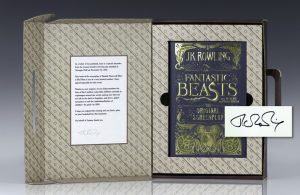
Fantastic Beasts and Where To Find Them – Intro to signed edition

Index ID: INTFBSE — Publication date: November 12, 2016

Note: This signed copy of the Fantastic Beasts and Where to Find Them screenplay was for some people who attended the event with J.K. Rowling at Carnegie Hall, in 2016. However, in 2017, Lumos made available 10 more copies of this signed book for the first 10 people who donated $2,500.

As a token of my gratitude, here is a special keepsake from the Lumos benefit screening you attended at Carnegie Hall on November 12, 2016.

This book of the screenplay of Fantastic Beasts and Where to Find Them is one of a very limited number I have signed especially for this event.

Thanks to your support, we can help transform the lives of the 8 million vulnerable children currently in orphanages around the world, making sure they are not left in the dark or forgotten, and drive a global movement to end the institutionalization of children -for good- by 2050.

I hope you enjoyed the evening and can find a place on your bookshelf for this memento.

On behalf of Lumos, thank you.

J.K. Rowling


The following images are related to this writing


Previous writing: «

Next writing: »

Violent Femmes album for RAM

Index ID: VFRAM — Publication date: September 1st, 2016

I’m not quite sure how the Violent Femmes passed me by. I turned 18 the year this album came out, but I was obsessed with The Beatles at the time. Of contemporary bands I really loved, the standouts were the Smiths and the Psychedelic Furs. I loved any band with a great guitarist. I played guitar myself, mostly alone in my bedroom.

It’s possible that I heard the Violent Femmes but I’ve forgotten. They could easily have been part of the informal seminars on alternative music I received from the muso I dated in my late teens. His parents were Dutch and we hung out mostly at his house, because we were allowed to smoke in his attic bedroom. I’ve got happy memories of sunlit wooden rafters and smoke rings and walls covered in black and white pictures he’d clipped out of NME, while the Dead Kennedys, Jah Wobble or the Birthday Party blasted out of the speakers. Setting aside the fact that I had a pair of very long-lived goldfish named after Guggi and Gavin of the Virgin Prunes, I never became a whole-hearted convert of his favourite bands. Much as I adored him, I didn’t share Muso Boyfriend’s attitude to music: his scorn for the accessible and tuneful, the baffling mixture of irony and obsession with which he regarded his favourites, and his conviction that if the herd hates something, it’s almost certainly brilliant.

The NME was Muso Boyfriend’s bible and it took a hard line on nearly anything commercial or popular, talking about bands in the top ten with the kind of contempt most people reserve for child abusers. A few real Gods could be forgiven commercial success, obviously: people like Bowie or the Stones, but the likes of Nik Kershaw might as well have been Thatcher herself as far as NME were concerned

When the Stranglers released ‘Feline’ and it went to number 4 in the album charts, an NME journo went into meltdown, ranting about the fact that people who’d never heard ‘Rattus Norvegicus’ were now calling themselves Stranglers fans. You could almost see the flecks of spittle on the page. (I’d bought ‘Feline.’ I didn’t own ‘Rattus Norvegicus.’) And I still vividly remember an NME interview with Gary Kemp from Spandau Ballet, a band I never liked, though I admired Gary’s chutzpah in agreeing to talk to them. The interviewer’s disapproval of Gary and everything he stood for reached a glorious peak with the phrase ‘this whorehouse called success.’ I never made much headway arguing about this sort of thing with Muso Boyfriend, though, so after a bit of snogging I’d cycle home and listen to ‘Rubber Soul.’

My first live gig and my first music festival were both with Muso Boyfriend: Big Country at Dingwalls in Bristol, supporting act: John Cooper Clarke, the punk poet. We spent my 18th birthday at the Elephant Fayre in Cornwall, hitching there from South Wales. I’d told my parents some whopping lie about how we were getting there, probably that Muso Boyfriend’s older brother was driving us. Half an hour of unsuccessful hitching later, it suddenly occurred to me that my parents had said they were going shopping later. This meant they might soon be driving past us, so I kept diving for cover every time a Honda Civic came into view.

We finally got a lift, thank God, so I survived to enjoy my birthday at the Elephant Fayre. We pitched the two-person tent by a marquee full of Rastas selling tea and hot knives and saw the Cure, whom Muso Boyfriend was weirdly keen to hear, in spite of the fact that they’d actually been on Top of the Pops. The only other act I remember well from the Elephant Fayre is Benjamin Zephaniah. He did a poem about having the shit kicked out of him by a policeman. Twenty odd years later, I was on a team with him at a kids’ book quiz at the Edinburgh Book Festival.

You’ve now listened to it, at least 3 times, what do you think?

I didn’t Google the band or the album before listening, because that felt like cheating, so I knew virtually nothing about them except that this came out in 1983. When I told my friend Euan which album I was going to review he assured me I’d like it, but his favourite album’s by The Cramps, so that wasn’t entirely reassuring.

Wanting to concentrate, I go outside to my writing room in the garden, which has a wooden ceiling. This, unlikely as it may seem, is relevant information.

So I put on the Violent Femmes and hear a catchy acoustic guitar riff and I think, this is great! I’m going to love them! I’ll get a Violent Femmes T-shirt, buy the entire back catalogue and bore everyone rigid with my new obsession!

But then the vocalist kicks in and I have an immediate, visceral response of ‘no, scratch everything, I hate this.’ The change of mood is so abrupt my mind goes blank. I try to analyse why I moved from appreciation to intense dislike in a matter of seconds, but the best I can do is ‘I’ve heard voices like that before.’

By the time I reach track seven, all I can think about is the Toy Dolls’ cover of Nelly the Elephant. I’m not proud. I know this says more about me than the Violent Femmes.

After I’ve listened to the whole album once, I look down at the place where I was supposed to be making notes and all I’ve written is: ‘his upper register sounds like a bee in a plastic cup,’ which the professional writer in me recognizes as ‘not 500 words’. Feeling glum, I postpone a second listen to the following day.

It’s raining next morning and I can’t be bothered to go and find shoes, so I don’t take the album into the writing room, but stay in the kitchen. With minimal enthusiasm, I put on the album again.

This is weird. The vocalist is actually, um… good. Where did the bloke I heard yesterday go? Now I’m not busy hating him, I notice all the great hooks and how they sometimes sound like a manic skiffle band. There’s a nice bit of bluesy slide guitar and an actual xylophone on ‘Gone Daddy Gone’. Plus, when he half talks, half sings, Gordon Gano (I checked the album credits) sounds a bit Lou Reed, and I love Lou Reed. Apart from being the vocalist, Gano also happens to be the guitarist I fell for yesterday.

I can’t understand why he grated on me so much first time round. Beneath my wooden ceiling, he was the Ur-voice of all those NME-approved punky bands I never liked: nasal, whiny and brash. Today, sitting beside my kettle, he’s raw, catchy and soulful.

Only then, staring into a mug of tea, do I have the little epiphany that you, clever reader, saw coming a mile off. Listening to an album that reeks of 1983, in a room that bears a passing resemblance to that attic of long ago, was a mistake. It wasn’t Gordon Gano who was the problem: it was me. I was listening with a ghostly eighteen year old ex-boyfriend at my shoulder, and behind him, a chorus of snarling early eighties NME journalists, all ready to jeer, because even if I like the Violent Femmes, I’ll like them in the wrong way.

So the sun came out and I took the Violent Femmes back across the wet lawn into the writing room, telling myself that it’s not 1983 any more, and this is between me and the Violent Femmes, nobody else. On the third listen, I realized that I loved the album. Before I knew it, I was listening to it over and over again. Only then did I let myself look at their Wikipedia page.

The Violent Femmes, I read, were ‘one of the most successful alternative rock bands of the 1980s, selling over 9 million albums by 2005.’ Yes, the Violent Femmes ended up in that whorehouse called success, and you know what? It only makes me love them more.


Previous writing: «

Next writing: »

Lumos Charm Bracelet

Index ID: LCBR — Publication date: June 30th, 2016

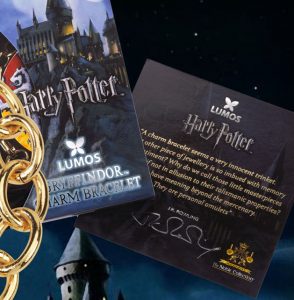
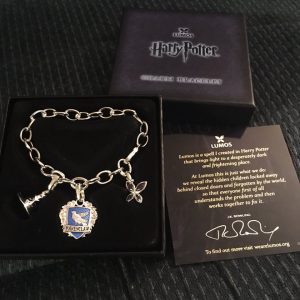
Note: Warner Bros. and movie prop and merchandise specialist The Noble Collection have created the Lumos Harry Potter Charm Bracelet Collection, available to purchase through The Noble Collection shop. At least 15% of the suggested retail price of the charm bracelet will go to Lumos Foundation. They included a presentation card with a message by J.K. Rowling.

A charm bracelet seems a very innocent trinket. What other piece of jewellery is so imbued with memory and sentiment? Why do we call those little masterpieces “charms” if not in allusion to their talismanic properties? They have meaning beyond the mercenary. They are personal amulets.

Lumos is a spell I created in HARRY POTTER that brings light to a desperately dark and frightening place.

At Lumos this is just what we do: we reveal the hidden children locked away behind closed doors and forgotten by the world, so that everyone first of all understands the problem and then works together to fix it.


The following images are related to this writing


Previous writing: «

Next writing: »

On Monsters, Villains and the EU Referendum

Index ID: EUREF — Publication date: June 30th, 2016

I’m not an expert on much, but I do know how to create a monster.

All enduring fictional bad guys encapsulate primal terrors and share certain traits. Invincible to the point of immortality, they commit atrocities without conscience and cannot be defeated by the ordinary man or by conventional means. Hannibal Lecter, Big Brother, and Lord Voldemort: all are simultaneously inhuman and superhuman and that is what frightens us most.

As this country has entered what will come to be seen as one of the most divisive and bitter political campaigns ever waged within its borders, I’ve thought a lot about the rules for creating villains. We are being asked whether we wish to remain part of the European Union and both sides of this campaign have been telling us stories. I don’t mean that in the sense of lying (although lies have certainly been told). I mean that they are appealing to us through our universal need to make sense of the world by storytelling and that they have not been afraid to conjure monsters calculated to stir up our deepest fears.

This is nothing new, of course. All political campaigns tell stories. They cast themselves as our champions, flatter us with tales of who we are or could be, sell us rose-tinted memories of the past and draw frightening pictures of the perils that lie ahead if we pick the wrong heroes. Nevertheless, the tales we have been told during this referendum have been uglier than any I can remember in my lifetime. If anyone has enjoyed this referendum, it can only be those hoping for greater personal power at the end of it.

The Leave campaign’s narrative has descended to this: we are being exploited or cheated by the EU. If we can’t see that Britain will only regain superpower status if we leave the union, we must be unpatriotic, cowardly or part of a corrupt elite.

Remainers have mostly countered, not with an optimistic vision of the union, but with bleak facts: money is pouring out of the country at the prospect of the Brexit and experts in every field think that leaving the EU will be a catastrophic mistake. Be afraid, says Remain, turn back while there’s still time: you are hurtling towards a precipice.

However, Remain are finding many ears closed to their grim prognostications. The economic crash of 2008 left a pervasive feeling in its wake that financial institutions are not to be trusted. ‘The establishment’ has become a term of blanket abuse. We live in a cynical and insecure age. Trust in disinterested sources has been shaken, while popular culture glorifies the hunch and the gut feeling. In America, they call this ‘post-truth politics’. Forget the facts, feel the fury.
The ‘Leave’ campaign is benefiting from our widespread cynicism and, unsurprisingly, fanning it. ‘People in this country have had enough of experts,’ Michael Gove declared recently on television. So what if the Financial Times, the markets and the heads of the Bank of England and the International Monetary Fund agree that Brexit will do severe damage to the economy? They’re just scaremongering, says Gove. Leaders of both campaigns want us frightened only by monsters of their choosing.

For some on the Leave side, the EU is not merely imperfect, or in need of improvement: it is villainous. The union that was born out of a collective desire never to see another war in Europe is depicted as an Orwellian monolith, Big Brotheresque in its desire for control.

Widespread confusion about what the EU does and does not do has been helpful to Leave. The results of a recent IPSOS/Mori poll reveal the depth of our ignorance. We dramatically underestimate the amount of international investment we receive from the EU, while grossly overestimating how many laws it makes, how much it spends on administration and the number of EU immigrants in this country. In some cases our guesses were out by factors of ten.
Immigrants, of course, have been at the centre of some of the nastiest arguments of this campaign. Reasoned discussion has proven nigh on impossible. Remainers insist that we retain border control and that we need immigration, not least because so many of our medical staff running the NHS come from abroad. They insist that our defensive capability and our anti-terrorist strategies are enhanced by membership of the EU. Their arguments have proven only partially successful, because Leave has been busy threatening us with another montster: a tsunami of faceless foreigners heading for our shores, among them rapists and terrorists.

It is dishonourable to suggest, as many have, that Leavers are all racists and bigots: they aren’t and it is shameful to suggest that they are. Nevertheless, it is equally nonsensical to pretend that racists and bigots aren’t flocking to the ‘Leave’ cause, or that they aren’t, in some instances, directing it. For some of us, that fact alone is enough to give us pause. The picture of Nigel Farage standing in front of a poster showing a winding line of Syrian refugees captioned ‘Breaking Point’ is, as countless people have already pointed out, an almost exact duplicate of propaganda used by the Nazis.

Nationalism is on the march across the Western world, feeding upon the terrors it seeks to inflame. Every nationalist will tell you that their nationalism is different, a natural, benign response to their country’s own particular needs and challenges, nothing to do with that nationalism of yore that ended up killing people, yet every academic study of nationalism has revealed the same key features. Your country is the greatest in the world, the nationalist cries, and anyone who isn’t chanting that is a traitor! Drape yourself in the flag: doesn’t that make you feel bigger and more powerful? Finding the present scary? We’ve got a golden past to sell you, a mythical age that will dawn again once we’ve got rid of the Mexicans/left the EU/annexed Ukraine! Now place your trust in our simplistic slogans and enjoy your rage aginst the Other!

Look towards the Republican Party in America and shudder. ‘Make America Great Again!’ cries a man who is fascist in all but name. His stubby fingers are currently within horrifyingly close reach of America’s nuclear codes. He achieved this pre-eminence by proposing crude, unworkable solutions to complex threats. Terrorism? ‘Ban all Muslims!’ Immigration? ‘Build a wall!’ He has the temperament of an unstable nightclub bouncer, jeers at violence when it breaks out at his rallies and wears his disdain for women and minorities with pride. God help America. God help us all.

Donald Trump supports the break up of the EU. The inheritor of a family fortune, he has never needed to cooperate or collaborate and he appears incapable of understanding complexity or nuance. Of foreign leaders or would-be leaders, Trump is joined only by Vladimir Putin and Marine le Pen in urging Brexit upon the UK. Other than those three, there is no major political leader who isn’t begging Britain to stay put, for the political and economic stability of Europe and the wider world.

I’m the mongrel product of this European continent and I’m an internationalist. I was raised by a Francophile mother whose family was proud of their part-French heritage. My French ancestors lived in the troubled province of Alsace, which spent hundreds of years being

alternately annexed by Germany and France. I’ve lived in France and Portugal and I’ve studied French and German. I love having these mulitple allegiances and cultural associations. They make me stronger, not weaker. I glory in association with the cultures of my fellow Europeans. My values are not contained or proscribed by borders. The absence of a visa when I cross the channel has symbolic value to me. I might not be in my house, but I’m still in my hometown.

The ‘Leave’ campaign is selling itself as the courageous option. Take a leap of faith, they say. Step off the cliff and let the flag catch you! With the arrogance of a bunch of mini- Trumps they swear that everything will be glorious as long as we disregard the experts and listen to them. Embrace the rage and trust your guts, which Nigel Farage undoubtedly hopes contain a suspicion of brown people, an unthinking jingoism and an indifference to the warnings of history.

For many of our countrymen, I suspect a ‘Leave’ vote will be a simple howl of frustration, a giant two fingers to the spectres that haunt our imaginations, against terrorism that seems almost supernatural in its ability to hit us in our most vulnerable places, against huge corporations who refuse to meet their basic moral obligations, against bureaucracy we are afraid will strangle us, against shadowy elites we are told are working to do us down. How easy to project all of this onto the EU, how satisfying to turn this referendum into a protest against everything about modern life that scares us, whether rationally or not.

Yet how can a retreat into selfish and insecure individualism be the right response when Europe faces genuine threats, when the bonds that tie us are so powerful, when we have come so far together? How can we hope to conquer the enormous challenges of terrorism and climate change without cooperation and collaboration?

No, I don’t think the EU’s perfect. Which human union couldn’t use improvement? From friendships, marriages, families and workplaces, all the way up to political parties, governments and cultural economic unions, there will be flaws and disagreements. Because we’re human. Because we’re imperfect. So why bother building these ambitious alliances and communities? Because they protect and empower us, because they enable bigger and better achievements than we can manage alone. We should be proud of our enduring desire to join together, seeking better, safer, fairer lives, for ourselves and for millions of others.

The research demonstrates that we don’t know what we’ve got. Ignorant of what it gives us, we take the benefits of EU membership for granted. In a few days’ time, we’ll have to decide which monsters we believe are real and which illusory. Everything is going to come down to whose story we like best, but at the moment we vote, we stop being readers and become authors. The ending of this story, whether happy or not, will be written by us.


Previous writing: «

Next writing: »

Why Dumbledore went to the hilltop

Index ID: DMBHT — Publication date: October 27th, 2015

Note: Published original in TwitLonger: https://www.twitlonger.com/show/n_1sno25c and linked from this tweet: https://twitter.com/jk_rowling/status/658993229094895617

I’ve received a lot of messages over the past few days that use my fictional characters to make points about the Israeli cultural boycott. This isn’t a complaint: those characters belong to the readers as well as to me, and each has their own life in the heads of those who have read them. Sometimes the inner lives of characters as imagined by readers are not what I imagined for them, but the joy of books is that we all make our own mental cast. I’ve always enjoyed hearing about versions of Potter characters that exist in heads other than mine.

Many of the messages I’ve received in the last few days have included variations on the theme ‘talking wouldn’t stop the Wizarding War’ and as far as that goes, it’s true. Talking alone would not have stopped the Wizarding War and talking alone didn’t. Voldemort believed that non-wizards were subhuman, so it’s valid to draw comparisons between Voldemort and any real human being who regards other races, religions or sexualities as inferior. It would indeed have been a fool’s errand to try and talk Voldemort or Bellatrix Lestrange into laying down their wands for love of their fellow humans. They have no love of humanity and they wanted domination, not peace.

I said above, and I stand by it, that every reader has the right to his or her own version of my characters. However, there is one central point about the Potter stories that is not negotiable: we can’t pretend that it isn’t there, or that it doesn’t matter, when it is the crux of the books and in many ways the key to the story. It is also a point that to my knowledge (I get a lot of messages, so I cannot swear to it) has been lost in the many comparisons of Israel to Death Eaters.

In the final book, Deathly Hallows, when many hidden things come to the surface, there is a scene on a windy hilltop. Dumbledore has been summoned by a Death Eater, Severus Snape. At that point, Snape is a subscriber to the inhuman philosophy of Voldemort. He is probably a killer, certainly a betrayer of two of the people Dumbledore loved most, and the man who had sent Voldemort after an innocent child in the knowledge that Voldemort would kill him.

Again, to my knowledge (my memory isn’t infallible, so forgive me if you did), nobody has ever asked me: why did Dumbledore go when Snape asked him to go, and why didn’t he kill him on sight when he got there?

I think readers assume that Dumbledore is wise enough, knowledgeable enough and compassionate enough to sense that Snape, though he has led a despicable adult life, has something human left inside him, something that can be redeemed. Nevertheless, wise and prescient as Dumbledore is, he is not a Seer. At the moment when he answers Snape’s call, he cannot know that Snape isn’t going to try and kill him. He can’t know that Snape will have the moral or physical courage to change course, let alone help defeat Voldemort. Yet still, Dumbledore goes to the hilltop.

I’m going to digress very slightly here, but there is a related point that bears making. Among the messages drawing parallels between the Potter books and Israel have been quite a few saying that ‘Harry would be disappointed’ or ‘Harry wouldn’t understand’ my position. Those people are right, but only up to a clearly defined point. The Harry of six and a half books might not understand. Harry is reckless and angry for a considerable portion of those six and a half books and he has my whole-hearted sympathy. He has lost his family, he has had burdens put upon him that he never wanted, and he has been stigmatised all through his adolescence for carrying a scar left on him by a killer.

There comes a moment in the final book, though, when Harry, whose natural inclination is to fight, to rush to action, to lead from the front, is forced to stop and consider the cryptic message the dead Dumbledore has left him. Unfortunately, this message runs against counter to everything that Harry believes is necessary to win the war. He wants to race Voldemort to a deadly weapon, but Dumbledore has arranged things so that, while Harry will know that the weapon exists, he will also suspect that taking the weapon is the wrong thing to do. Harry cannot understand why using that weapon would be harmful, yet – grudgingly – he decides to act against his own instinct, and according to what he believes are Dumbledore’s wishes. The decision sits uncomfortably with him. He remains doubtful about it almost up to the point where he comes face-to-face with Voldemort for their final encounter.

Unlike Harry, Dumbledore was not acting against his own nature when he chose to meet Snape on the hilltop. Dumbledore, remember, is not a politician; the Ministry is weak and corrupt, it enabled Voldemort’s rise and is now doing a poor job of fighting him. Dumbledore is an academic and he believes that certain channels of communication should always remain open. It was true in the Potter books and it is true in life that talking will not change wilfully closed minds. However, the course of my fictional war was forever changed when Snape chose to abandon the course on which he was set, and Dumbledore helped him do it. Theirs was a partnership without which Harry’s willingness to fight would have been pointless.

The Palestinian community has suffered untold injustice and brutality. I want to see the Israeli government held to account for that injustice and brutality. Boycotting Israel on every possible front has its allure. It satisfies the human urge to do something, anything, in the face of horrific human suffering.

What sits uncomfortably with me is that severing contact with Israel’s cultural and academic community means refusing to engage with some of the Israelis who are most pro-Palestinian, and most critical of Israel’s government. Those are voices I’d like to hear amplified, not silenced. A cultural boycott places immovable barriers between artists and academics who want to talk to each other, understand each other and work side-by-side for peace. I believe in the power of projects like this http://ow.ly/TSYCp and this http://ow.ly/TSZYx and this http://ow.ly/TSYik. I think it is a tragedy when medical research like this http://ow.ly/TSYoD is prevented.

I genuinely don’t take it in ill part when you send me counterarguments framed in terms of the Potter books. All books dealing with morality can be picked apart for those lines and themes that best suit the arguer’s perspective. I can only say that a full discussion of morality within the series is impossible without examining Dumbledore’s actions, because he is the moral heart of the books. He did not consider all weapons equal and he was prepared, always, to go to the hilltop.


Previous writing: «

Next writing: »

Very Good Lives

Index ID: VGL — Publication date: April 14th, 2015

Note: In 2008, J.K. Rowling delivered a deeply affecting commencement speech at Harvard University. It was published later as a book.
Only the beginning of this text can be displayed here for research purposes. I apologize!

President Faust, members of the Harvard Corporation and the Board of Overseers, members of the faculty, proud parents, and, above all, graduates.


Previous writing: «

Next writing: »

Draco Malfoy

Index ID: DMPM — Publication date: Decemer 22nd, 2014

New from J.K. Rowling

Draco Malfoy grew up as an only child at Malfoy Manor, the magnificent mansion in Wiltshire which had been in his family’s possession for many centuries. From the time when he could talk, it was made clear to him that he was triply special: firstly as a wizard, secondly as a pure-blood, and thirdly as a member of the Malfoy family.

Draco was raised in an atmosphere of regret that the Dark Lord had not succeeded in taking command of the wizarding community, although he was prudently reminded that such sentiments ought not to be expressed outside the small circle of the family and their close friends ‘or Daddy might get into trouble’. In childhood, Draco associated mainly with the pure-blood children of his father’s ex-Death Eater cronies, and therefore arrived at Hogwarts with a small gang of friends already made, including Theodore Nott and Vincent Crabbe.

Like every other child of Harry Potter’s age, Draco heard stories of the Boy Who Lived through his youth. Many different theories had been in circulation for years as to how Harry survived what should have been a lethal attack, and one of the most persistent was that Harry himself was a great Dark wizard. The fact that he had been removed from the wizarding community seemed (to wishful thinkers) to support this view, and Draco’s father, wily Lucius Malfoy, was one of those who subscribed most eagerly to the theory. It was comforting to think that he, Lucius, might be in for a second chance of world domination, should this Potter boy prove to be another, and greater, pure-blood champion. It was, therefore, in the knowledge that he was doing nothing of which his father would disapprove, and in the hope that he might be able to relay some interesting news home, that Draco Malfoy offered Harry Potter his hand when he realised who he was on the Hogwarts Express. Harry’s refusal of Draco’s friendly overtures, and the fact that he had already formed allegiance to Ron Weasley, whose family is anathema to the Malfoys, turns Malfoy against him at once. Draco realised, correctly, that the wild hopes of the ex-Death Eaters – that Harry Potter was another, and better, Voldemort – are completely unfounded, and their mutual enmity is assured from that point.

Much of Draco’s behaviour at school was modelled on the most impressive person he knew – his father – and he faithfully copied Lucius’s cold and contemptuous manner to everyone outside his inner circle. Having recruited a second henchman (Crabbe being already in position pre-Hogwarts) on the train to school, the less physically imposing Malfoy used Crabbe and Goyle as a combination of henchman and bodyguard throughout his six years of school life.

Draco’s feelings for Harry were always based, in a great part, on envy. Though he never sought fame, Harry was unquestionably the most talked-about and admired person at school, and this naturally jarred with a boy who had been brought up to believe that he occupied an almost royal position within the wizarding community. What was more, Harry was most talented at flying, the one skill at which Malfoy had been confident he would outshine all the other first-years. The fact that the Potions master, Snape, had a soft spot for Malfoy, and despised Harry, was only slight compensation.

Draco resorted to many different dirty tactics in his perpetual quest to get under Harry’s skin, or discredit him in the eyes of others including, but not limited to, telling lies about him to the press, manufacturing insulting badges to wear about him, attempting to curse him from behind, and dressing up as one of the Dementors (to which Harry had shown himself particularly vulnerable). However, Malfoy had his own moments of humiliation at Harry’s hands, notably on the Quidditch pitch, and never forgot the shame of being turned into a bouncing ferret by a Defence Against the Dark Arts teacher.

While many people thought that Harry Potter, who had witnessed the Dark Lord’s rebirth, was a liar or a fantasist, Draco Malfoy was one of the few who knew that Harry was telling the truth. His own father had felt his Dark Mark burn and had flown to rejoin the Dark Lord, witnessing Harry and Voldemort’s graveyard duel.

The discussions of these events at Malfoy Manor gave rise to conflicting sensations in Draco Malfoy. On the one hand, he was thrilled by the secret knowledge that Voldemort had returned, and that what his father had always described as the family’s glory days were back once more. On the other, the whispered discussions about the way that Harry had, again, evaded the Dark Lord’s attempts to kill him, caused Draco further twinges of anger and envy. Much as the Death Eaters disliked Harry as an obstacle and as a symbol, he was discussed seriously as an adversary, whereas Draco was still relegated to the status of schoolboy by Death Eaters who met at his parents’ house. Though they were on opposing sides of the gathering battle, Draco felt envious of Harry’s status. He cheered himself up by imagining Voldemort’s triumph, seeing his family honoured under a new regime, and he himself feted at Hogwarts as the important and impressive son of Voldemort’s second-in-command.

School life took an upturn in Draco’s fifth year. Although forbidden to discuss at Hogwarts what he had heard at home, Draco took pleasure in petty triumphs: he was a Prefect (and Harry was not) and Dolores Umbridge, the new Defence Against the Dark Arts teacher, seemed to loathe Harry quite as much as he did. He became a member of Dolores Umbridge’s Inquisitorial Squad, and made it his business to try and discover what Harry and a gang of disparate students were up to, as they formed and trained, in secret, as the forbidden organisation, Dumbledore’s Army. However, at the very moment of triumph, when Draco had cornered Harry and his comrades, and when it seemed that Harry must be expelled by Umbridge, Harry slipped through his fingers. Worse still, Harry managed to thwart Lucius Malfoy’s attempt to kill him, and Draco’s father was captured and sent to Azkaban.

Draco’s world now fell apart. From having been, as he and his father had believed, on the cusp of authority and prestige such as they had never known before, his father was taken from the family home and imprisoned, far away, in the fearsome wizard prison guarded by Dementors. Lucius had been Draco’s role model and hero since birth. Now he and his mother were pariahs among the Death Eaters; Lucius was a failure and discredited in the eyes of the furious Lord Voldemort.

Draco’s existence had been cloistered and protected until this point; he had been a privileged boy with little to trouble him, assured of his status in the world and with his head full of petty concerns. Now, with his father gone and his mother distraught and afraid, he had to assume a man’s responsibilities.

Worse was to come. Voldemort, seeking to punish Lucius Malfoy still further for the botched capture of Harry, demanded that Draco perform a task so difficult that he would almost certainly fail – and pay with his life. Draco was to murder Albus Dumbledore – how, Voldemort did not trouble to say. Draco was to be left to his own initiative and Narcissa guessed, correctly, that her son was being set up to fail by a wizard who was devoid of pity and could not tolerate failure.

Furious at the world that seemed suddenly to have turned on his father, Draco accepted full membership of the Death Eaters and agreed to perform the murder Voldemort ordered. At this early stage, full of the desire for revenge and to return his father to Voldemort’s favour, Draco barely comprehended what he was being asked to do. All he knew was that Dumbledore represented everything his imprisoned father disliked; Draco managed, quite easily, to convince himself that he, too, thought the world would be a better place without the Hogwarts Headmaster, around whom opposition to Voldemort had always rallied.

In thrall to the idea of himself as a real Death Eater, Draco set off for Hogwarts with a burning sense of purpose. Gradually, however, as he found that his task was much more difficult than he had anticipated, and after he had come close to accidentally killing two other people instead of Dumbledore, Draco’s nerve began to fail. With the threat of harm to his family and himself hanging over him, he began to crumble under the pressure. The ideas that Draco had about himself, and his place in the world, were disintegrating. All his life, he had idolised a father who advocated violence and was not afraid to use it himself, and now that his son discovered in himself a distaste for murder, he felt it to be a shameful failing. Even so, he could not free himself from his conditioning: he repeatedly refused the assistance of Severus Snape, because he was afraid that Snape would attempt to steal his ‘glory’.

Voldemort and Snape underestimated Draco. He proved an adept at Occlumency (the magical art of repelling attempts to read the mind), which was essential for the undercover work he had undertaken. After two doomed attempts on Dumbledore’s life, Draco succeeded in his ingenious plan to introduce a whole group of Death Eaters into Hogwarts, with the result that Dumbledore was, indeed, killed – though not by Draco’s hand.

Even when faced with a weak and wandless Dumbledore, Draco found himself unable to deliver the coup de grâce because, in spite of himself, he was touched by Dumbledore’s kindness and pity for his would-be killer. Snape subsequently covered for Draco, lying to Voldemort about Draco lowering his wand prior to his own arrival at the top of the Astronomy Tower; Snape emphasised Draco’s skill in introducing the Death Eaters into the school, and cornering Dumbledore for him, Snape, to kill.

When Lucius was freed from Azkaban shortly afterwards, the family was allowed to return to Malfoy Manor with their lives. However, they were now completely discredited. From dreams of the highest status under Voldemort’s new regime, the Malfoys found themselves the lowest in the ranks of the Death Eaters; weaklings and failures, to whom Voldemort was henceforth derisive and contemptuous.

Draco’s changed, yet still conflicted, personality revealed itself in his actions during the remainder of the war between Voldemort and those who were trying to stop him. Although Draco had still not rid himself of the hope of returning the family to their former high position, his inconveniently awakened conscience led him to try – half-heartedly, perhaps, but arguably as best he could in the circumstances – to save Harry from Voldemort when the former was captured and dragged to Malfoy Manor. During the final battle at Hogwarts however, Malfoy made yet another attempt to capture Harry and thereby save his parents’ prestige, and possibly their lives. Whether he could have brought himself to actually hand over Harry is a moot point; I suspect that, as with his attempted murder of Dumbledore, he would again have found the reality of bringing about another person’s death much more difficult in practice than in theory.

Draco survived Voldemort’s siege of Hogwarts because Harry and Ron saved his life. Following the battle, his father evaded prison by providing evidence against fellow Death Eaters, helping to ensure the capture of many of Lord Voldemort’s followers who had fled into hiding.

The events of Draco’s late teens forever changed his life. He had had the beliefs with which he had grown up challenged in the most frightening way: he had experienced terror and despair, seen his parents suffer for their allegiance, and had witnessed the crumbling of all that his family had believed in. People whom Draco had been raised, or else had learned, to hate, such as Dumbledore, had offered him help and kindness, and Harry Potter had given him his life. After the events of the second wizarding war, Lucius found his son as affectionate as ever, but refusing to follow the same old pure-blood line.

Draco married the younger sister of a fellow Slytherin. Astoria Greengrass, who had gone through a similar (though less violent and frightening) conversion from pure-blood ideals to a more tolerant life view, was felt by Narcissa and Lucius to be something of a disappointment as a daughter-in-law. They had had high hopes of a girl whose family featured on the ‘Sacred Twenty-Eight’, but as Astoria refused to raise their grandson Scorpius in the belief that Muggles were scum, family gatherings were often fraught with tension.

J.K. Rowling’s thoughts

When the series begins, Draco is, in almost every way, the archetypal bully. With the unquestioning belief in his own superior status he has imbibed from his pure-blood parents, he initially offers Harry friendship on the assumption that the offer needs only to be made to be accepted. The wealth of his family stands in contrast to the poverty of the Weasleys; this too, is a source of pride to Draco, even though the Weasleys’ blood credentials are identical to his own.

Everybody recognises Draco because everybody has known somebody like him. Such people’s belief in their own superiority can be infuriating, laughable or intimidating, depending on the circumstances in which one meets them. Draco succeeds in provoking all of these feelings in Harry, Ron and Hermione at one time or another.

My British editor questioned the fact that Draco was so accomplished at Occlumency, which Harry (for all his ability in producing a Patronus so young) never mastered. I argued that it was perfectly consistent with Draco’s character that he would find it easy to shut down emotion, to compartmentalise, and to deny essential parts of himself. Dumbledore tells Harry, at the end of Order of the Phoenix, that it is an essential part of his humanity that he can feel such pain; with Draco, I was attempting to show that the denial of pain and the suppression of inner conflict can only lead to a damaged person (who is much more likely to inflict damage on other people).

Draco never realises that he becomes, for the best part of a year, the true owner of the Elder Wand. It is as well that he does not, partly because the Dark Lord is skilled in Legilimency, and would have killed Draco in a heartbeat if he had had an inkling of the truth, but also because, his latent conscience notwithstanding, Draco remains prey to all the temptations that he has been taught to admire – violence and power among them.

I pity Draco, just as I feel sorry for Dudley. Being raised by either the Malfoys or the Dursleys would be a very damaging experience, and Draco undergoes dreadful trials as a direct result of his family’s misguided principles. However, the Malfoys do have a saving grace: they love each other. Draco is motivated quite as much by fear of something happening to his parents as to himself, while Narcissa risks everything when she lies to Voldemort at the end of Deathly Hallows and tells him that Harry is dead, merely so that she can get to her son.

For all this, Draco remains a person of dubious morality in the seven published books, and I have often had cause to remark on how unnerved I have been by the number of girls who fell for this particular fictional character (although I do not discount the appeal of Tom Felton, who plays Draco brilliantly in the films and, ironically, is about the nicest person you could meet). Draco has all the dark glamour of the anti-hero; girls are very apt to romanticise such people. All of this left me in the unenviable position of pouring cold common sense on ardent readers’ daydreams as I told them, rather severely, that Draco was not concealing a heart of gold under all that sneering and prejudice and that no, he and Harry were not destined to end up best friends.

I imagine that Draco grew up to lead a modified version of his father’s existence; independently wealthy, without any need to work, Draco inhabits Malfoy Manor with his wife and son. I see in his hobbies further confirmation of his dual nature. The collection of Dark artefacts harks back to family history, even though he keeps them in glass cases and does not use them. However, his strange interest in alchemical manuscripts, from which he never attempts to make a Philosopher’s Stone, hints at a wish for something other than wealth, perhaps even the wish to be a better man. I have high hopes that he will raise Scorpius to be a much kinder and more tolerant Malfoy than he was in his own youth.

Draco had many surnames before I settled on ‘Malfoy’. At various times in the earliest drafts he is Smart, Spinks or Spungen. His Christian name comes from a constellation – the dragon – and yet his wand core is of unicorn.

This was symbolic. There is, after all – and at the risk of re-kindling unhealthy fantasies – some unextinguished good at the heart of Draco.


Previous writing: «

Next writing: »