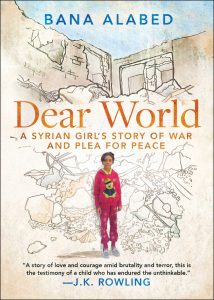
A story of love and courage amid brutality and terror, this is the testimony of a child who has endured the unthinkable.
The following images are related to this writing
Previous writing: « Lethal White
Next writing: Answers to Questions #3 »
Index ID: CQDW — Publication date: October 16th, 2018
A story of love and courage amid brutality and terror, this is the testimony of a child who has endured the unthinkable.
Previous writing: « Lethal White
Next writing: Answers to Questions #3 »
Index ID: LW — Publication date: September 18th, 2018
If only the swans would swim side by side on the dark green lake, this picture might turn out to be the crowning achievement of the wedding photographer’s career.
Previous writing: « Answers to Questions #2
Next writing: Cover quote: Dear World »
Index ID: AQ2 — Publication date: September 1st, 2018
1. How do you manage two very different fictional worlds (Cormoran Strike and the Wizarding World) and two very different formats (books and screenplays)?
I’ve never had any problem moving between fictional worlds, even if I’m working on them simultaneously. There can be a lot of hanging around waiting for notes on the draft of a movie script, so I like to have a novel on the go in the background.
I envision the different fictional worlds as different rooms to which I have access. At worst, when entering one of the rooms, I have to spend a bit of time re-orientating myself, finding my bearings again, checking what I’ve put in which drawers. However, they’re discrete places in my head, and the moment I re-enter one of the worlds, the characters are as fully real to me as when I left them. Cormoran Strike has never reached for a magic wand, and Newt Scamander doesn’t limp or drink Doom Bar.
The difference between screenplays and novels is more challenging. It isn’t that one is intrinsically easier than the other, but that I’m far less used to writing the former, whereas novels and I are old friends.
2. What comes first, plot or character?
I’m most interested in character, but plot usually comes first. I need to know the broad outline of the story before I start hatching characters. Having said that, a couple of stories have grown out of a single character. Character can be plot.
3. How do you come up with titles and how important are they?
Titles usually suggest themselves, but coming up with them always make me nervous. I think they’re quite important, which adds pressure. I have no idea what the third Beasts movie will be called, even though I already know the whole story. On the other hand, I already know the titles of the fifth Galbraith book and the children’s story I’m writing next.
4. Does the process of making film and TV put pressure on you to write faster, and do audiences’ reactions influence where you go with plot and how you develop characters?
Fan reactions to Harry Potter were both exhilarating and overwhelming, often at the same time. I saw it as my job back then to make sure that I arrived at the ending I had planned for the series before the first book was even published. The final destination was hugely important to me, for reasons that were both personal and artistic, and I plotted a course towards it despite being subjected to a lot of (almost entirely good-natured) buffeting from readers. Part of the fun of a series is the way people invest in the relationships from book to book (or film to film), and I love the fact that people have strong opinions on what should happen next. On the other hand, I never set pen to paper without knowing way more than will eventually appear on the page or screen, and I usually have a fairly strong idea of where I’m going, that won’t change.
In the case of the Beasts movies, I’m writing original screenplays, so there’s a practical need for the work to be done by a specific date so that filming can commence on time.
Where the Cormoran Strike novels are concerned, and even though I love the TV adaptations, I still finish the novel when it’s ready, no sooner! When I agreed to the books being adapted for TV I made it clear that the books would come as and when Robert Galbraith chose. Luckily, he loves writing them, so we should hopefully be seeing Strike on TV for some time to come.
5. Why choose Twitter rather than a well-placed press article or interview to make your opinions known?
Well, firstly that assumes that my main objective in tweeting is to ‘make my opinions known’ rather than what I think most people’s reason is for being on Twitter, which is to engage with other people, to debate and joke. I think for a lot of well-known people, it’s a bracing dose of normality. Nobody’s shy about telling you you’re an idiot. Twitter’s a great leveller. It isn’t for everyone, but nearly all the writers I know love it, because they’re in their own medium.
There’s a time and a place for a press article, but tweeting is something that happens for me on writing breaks. At its best, it’s fun and fascinating. People in all their diversity and strangeness interest me more than anything else on the planet, and Twitter is as good a place as I’ve ever found for seeing human nature in the raw!
Previous writing: « Answers to Questions #1
Next writing: Lethal White »
Index ID: AQ1 — Publication date: May 30th, 2018
1. What are you writing right now?
I’ve just finished the fourth Galbraith novel, Lethal White, and I’m now writing the screenplay for Fantastic Beasts 3. After that I’ll be writing another book for children. I’ve been playing with the (non-Harry Potter/wizarding world) story for about six years, so it’s about time I get it down on paper.
2. What is a typical writing day?
I try to start work before 9am. My writing room is probably my favourite place in the world. It’s in the garden, about a minute’s walk from the house. There’s a central room where I work, a kettle, a sink and a cupboard-sized bathroom. The radio is usually tuned to classical music, because I find human voices the most distracting when I’m working, although a background buzz, as in a café, is always comforting. I used to love writing in cafés and gave it up reluctantly, but part of the point of being alone in a crowd was being happily anonymous and free to people-watch, and when you’re the one being watched, you become too self-conscious to work.
The earlier in the day I start, the more productive I am. In the last year or two I’ve put in a couple of all-nighters on the screenplays for Fantastic Beasts, but otherwise I try and keep my writing to the daytime. If I’ve started around nine, I can usually work through to about 3pm before I need more than a short break. During this writing time, I generally manage to drink eight or nine mugs of tea. Being incredibly clumsy, prefer eating things that won’t ruin the keyboard when dropped. Popcorn’s ideal.
3. You have collaborated on several projects. How does that work?
By nature I’m quite solitary, so novels and I suit each other perfectly, but the collaborations I’ve been involved in have been pure joy, mainly because of the people involved.
For ten years I said no to proposals to adapt Harry for the stage, usually as a musical, and using the existing books. So when I met producers Sonia Friedman and Colin Callender, I wasn’t sure what I was going to hear. I only knew that they wanted to do something new, which was intriguing, because I had no desire to go endlessly back over old ground.
I couldn’t have asked for better collaborators on the stage play than John Tiffany (director) and Jack Thorne (writer). Incredibly, John and I knew each to say hello to years ago, when I used to write in the café at the Traverse Theatre in Edinburgh. When we met for the first time about Cursed Child, I stared at him, thinking, he looks so familiar, where have I met him? And he told me, and the whole thing felt oddly fated.
I told John and Jack what I thought had happened to Harry, Ron and Hermione in later years, explained how focused I was on Harry’s son Albus, who’d been given the burden of not one, but three legendary names, and together we created the story that Jack wrote.
I have so many wonderful memories of the earliest rehearsals, of seeing the costumes and illusions for the first time, but what I remember most fondly about the three of us working together is the laughter. I loved the process from beginning to end.
I particularly remember the first full dress rehearsal I watched. By this time I knew the script backwards, had heard it read all the way through and watched individual scenes acted, but nothing prepared me for seeing it in its entirety, in the theatre. I found it incredibly moving and it brought back a tsunami of memories about the seventeen years I spent creating the characters and writing the Harry Potter books. John and Jack did a superb job. Very few people have come inside the world with me and it creates a particular bond.
The big difference between theatre and movies for me is scale. When I go down to WB Studios Leavesden and see a thousand people at work on Fantastic Beasts, building sets, making costumes, doing digital effects, making models and props and all the hundreds of other things that go into making a movie, it can feel utterly overwhelming. Terrifying thoughts run through your mind, such as, I must not break an arm, because all these people’s jobs depend on me getting the screenplay finished.
However, at the heart of the process is a very similar collaboration to the one I had on Cursed Child, this time with David Yates, the director, and Steve Kloves, who was the writer on seven of the eight Potter films and is a producer on Beasts.
In spite of the fact that I’d watched Steve close up for all those years, I found screenwriting utterly different from novel writing and very challenging at first. Basically, I learned how to write a screenplay as I went along, knowing that the movie was definitely going to be made, which is, to say the least, atypical. Steve gives great, pithy notes. The one that made me laugh longest was when I had a character in a cut scene in an early draft say, ‘They’re children!’. He said, ‘Yeah, unless we’ve got the casting badly wrong, that’ll probably be obvious.’
David knows the world of Potter intimately now, after directing four of the eight original movies. I love working with him. I learn a lot just listening to him talk about images. Even though I have a highly visual imagination, I’ve had to learn just how much can be said onscreen without a word, and David and Steve have taught me that.
The thing with movies is, however frustrated you get with the screenwriting process, and right at the moment when you think ‘never again, this is too hard’, you go down to the film set and join in with one big glorious game of pretend, with the world’s best pretenders saying your words, and dressing out of the most fabulous dressing up box, and what with the lights and the smoke and the music you’re suddenly in love with the process all over again.
4. What exactly is your role as producer? How much say do you have in the look and feel of the films?
Warner Bros and David Yates, the director, have always let me have my say, though not necessarily the final word. That’s true of all the producers, of whom I’m only one: our input is taken seriously but it is very much a collaborative effort. The director is ultimately responsible for everything that’s seen on the screen. As the screenwriter, the majority of my input comes at an earlier stage.
5. Do you write for readers or for yourself?
This is a tricky question in some ways, because a writer who truly only wrote for themselves probably wouldn’t try and get published. At the same time, I agree with Cyril Connolly’s words: ‘Better to write for yourself and have no public, than write for the public and have no self.’
I certainly write ‘for myself’ in the sense that I have to write. It’s almost a compulsion. I need to do it. I don’t feel like myself if I’m not writing regularly, and I feel restless and odd if I have nothing to write, which these days is never, because I’ve got so many different projects on the go, by choice. I also write for myself in that I need to feel excited about a story to want to capture it on paper. I’m afraid I couldn’t write anything just because I knew people wanted it. The impetus always has to come from within.
On the other hand, no story lives unless someone is prepared to listen. As a writer, your highest aspiration is to touch people, to connect, to amuse or console. What could be more wonderful than hearing that your book helped somebody through a tough time? I think of the times when books have been my best consolation and source of strength, and I’m proud beyond words when I hear that anything I wrote did the same for other people.
Previous writing: « Cover quote: Poverty Safari
Next writing: Answers to Questions #2 »
Index ID: CQPS — Publication date: December 15th, 2017
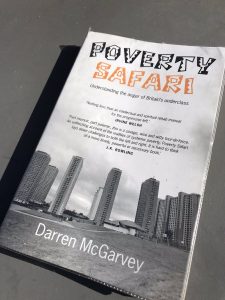
Part memoir, part polemic, this is a save, wise and witty tour-de-force. An unflinching account of the realities of systemic poverty. Poverty Safari lays down challenges to both the left and right. It is hard to thik of a more timely, powerful or necessary book.
Previous writing: « Twitter blocking
Next writing: Answers to Questions #1 »
Index ID: TWBLCK — Publication date: December 7th, 2017
I have one simple rule when I block people on Twitter, which I do very rarely. I block when my personal line has been crossed in terms of aggressive or insulting language.
Some recent publicity was given to the fact that I blocked a fan on Twitter. Contrary to the fan in question’s assertion, they were not blocked because they asked a question about Johnny Depp playing Grindelwald.
I saw several of this particular individual’s tweets by chance, and they were saying things to and about me, and about somebody with whom I work closely, that crossed the line of what I’m prepared to accept. The question about Grindelwald was not one of those tweets and I didn’t see it until the person in question began claiming that that was why they had been blocked.
Twitter has given me back a way of talking to readers directly and allows me a profound connection with a fandom that is, in the main, kind, tolerant and friendly. However, I have a duty towards my own mental health and happiness, too. The block button, is a useful last resort at times when somebody either forgets, or perhaps doesn’t care, that they are talking to a fellow human being.
Previous writing: « Grindelwald casting
Next writing: Cover quote: Poverty Safari »
Index ID: GGCAST — Publication date: December 7th, 2017
When Johnny Depp was cast as Grindelwald, I thought he’d be wonderful in the role. However, around the time of filming his cameo in the first movie, stories had appeared in the press that deeply concerned me and everyone most closely involved in the franchise.
Harry Potter fans had legitimate questions and concerns about our choice to continue with Johnny Depp in the role. As David Yates, long-time Potter director, has already said, we naturally considered the possibility of recasting. I understand why some have been confused and angry about why that didn’t happen.
The huge, mutually supportive community that has grown up around Harry Potter is one of the greatest joys of my life. For me personally, the inability to speak openly to fans about this issue has been difficult, frustrating and at times painful. However, the agreements that have been put in place to protect the privacy of two people, both of whom have expressed a desire to get on with their lives, must be respected. Based on our understanding of the circumstances, the filmmakers and I are not only comfortable sticking with our original casting, but genuinely happy to have Johnny playing a major character in the movies.
I’ve loved writing the first two screenplays and I can’t wait for fans to see ‘The Crimes of Grindelwald’. I accept that there will be those who are not satisfied with our choice of actor in the title role. However, conscience isn’t governable by committee. Within the fictional world and outside it, we all have to do what we believe to be the right thing.
Previous writing: « Foreword: The Little Big Things
Next writing: Twitter blocking »
Index ID: FWLBT — Publication date: September 7th, 2017
HENRY FRASER IS one of the most remarkable people I’ve ever met.
Prior to the accident that transformed his life, Henry was intelligent, gifted and handsome, which most of us would agree is quite enough to be going on with. Circumstances had not yet arranged themselves to reveal what an exceptional person Henry truly was. Then he went on holiday with his friends, dived into the ocean and everything changed in a second.
I first came across Henry’s story by chance. I’d only visited the Saracens rugby club website to check the details of a fixture mentioned in a whodunit I was writing. Henry’s story caught my eye and, in the grand tradition of all novelists doing research, I promptly abandoned what I was supposed to be doing and read something far more interesting.
A few weeks later, my friend and agent, Neil Blair, began telling me the story of a young man whom he had just taken on as a client. The story sounded very familiar. ‘Neil, this isn’t Henry Fraser, is it?’
And so, with a shared agent as my excuse, I got in touch with Henry. We chatted online for a while and finally met at his first art exhibition, which documented his mouth-painting journey from first drawings to beautiful, fully realised paitings. He made a speech that night that will, I’m sure, have staye with everyone who heard it. His honesty, his modesty, the unflinching way he described both his accident and the way he had adapted to and was making the most of a life he had not expected, were astonishing.
I follow Henry on Twitter and regularly chat with him by Direct Message. Most people respond to him the way I didh: admiration tinged with awe. Occasionally, though, I watch him dealing with another kind of attention. One woman told him he was being punished for stupidity in diving into the ocean from the beach. A man jeered at him for conning everyone; how could he use Twitter if he were really paralysed?
You can almost smell the fear in these unsolicited comments. Accepting the reality of Henry’s story means thinking about challenges and privations that some find too terryfying to contemplate. Apportioning blame is a way of trying to deflect the simple truth that annybody’s existence may undergo a sudden, irreversible, unavoidable change.
We humans are more fragile than we like to think. Fate forced Henry Fraser down a terrifyin path for which no preparation was possible. He had to find his own way back to a life worth living and in doing so he revealed himself to be a person of extraordinary perseverance, strength and wisdom. He pushes himself both physicaly and mentally, exceeding expectations in every direction, raising money for cuases he cares about, his art becoming more accomplished with every drawing and painting he produces.
Above all, Henry is living proof that acceptance and aspiration are not mutually exclusive. How many of us can truly say that we accept the present facts of our life, while living it to its fullest extent? It is understandable to rage against present limitations, but sometimes we make them our excuse not to act, not to do all that we can: for ourselves, for others, for the world.
Henry remains intelligent, gifted and handsome, but he is now something more, something rarer: someone truly inspirational. He is remarkable, not for what happened to him, but for what he makes happen. This book is merely his latest achievement, and nobody who knows him doubts that there is much more to come. I’m truly proud to count him one of my friends.
Previous writing: « Cover quote: How not to be a boy
Next writing: Grindelwald casting »
Index ID: CQHNBB — Publication date: August 29th, 2017
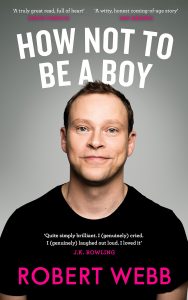
Quite simply brilliant. I (genuinely) cried. I (genuinely) laughed out loud. I loved it.
Previous writing: « Olivier Awards 2017 – Acceptance Speech
Next writing: Foreword: The Little Big Things »
Index ID: OAAS — Publication date: April 9th, 2017
I’ve never been sorrier not to be able to Apparate, because I’d give so much to be with the Cursed Child cast and creative team tonight.
My collaboration with Jack, John, Sonia, Colin and an extraordinary cast has been one of the most joyful and satisfying creative experiences in my life.
I knew they were all stupendously talented, but I never dreamed we’d create something quite so special together. And the reaction from audiences has been beyond all our wildest imaginations. And we’re all people with wild imaginations.
Thank you from the bottom of my heart to The Olivier Awards. It means everything to have the industry recognized the team behind the play.
And to every wonderful person who works on Cursed Child, ignore that old doom monger, Dumbledore. Tonight is a shining moment with no drop of poison in it.
Enjoy and have an extra drink from me.
Previous writing: « Fantastic Beasts and Where to Find Them (2017 updated edition)
Next writing: Cover quote: How not to be a boy »